Details
- Client
- Ambratic concept
- Theme
- Greek mythology, reissued
- Format
- Interactive story site
- Services
- Concept · Copy · Art direction · Motion
- Stack
- Next.js · GSAP · Lenis
- Year
- 2026
Introduction
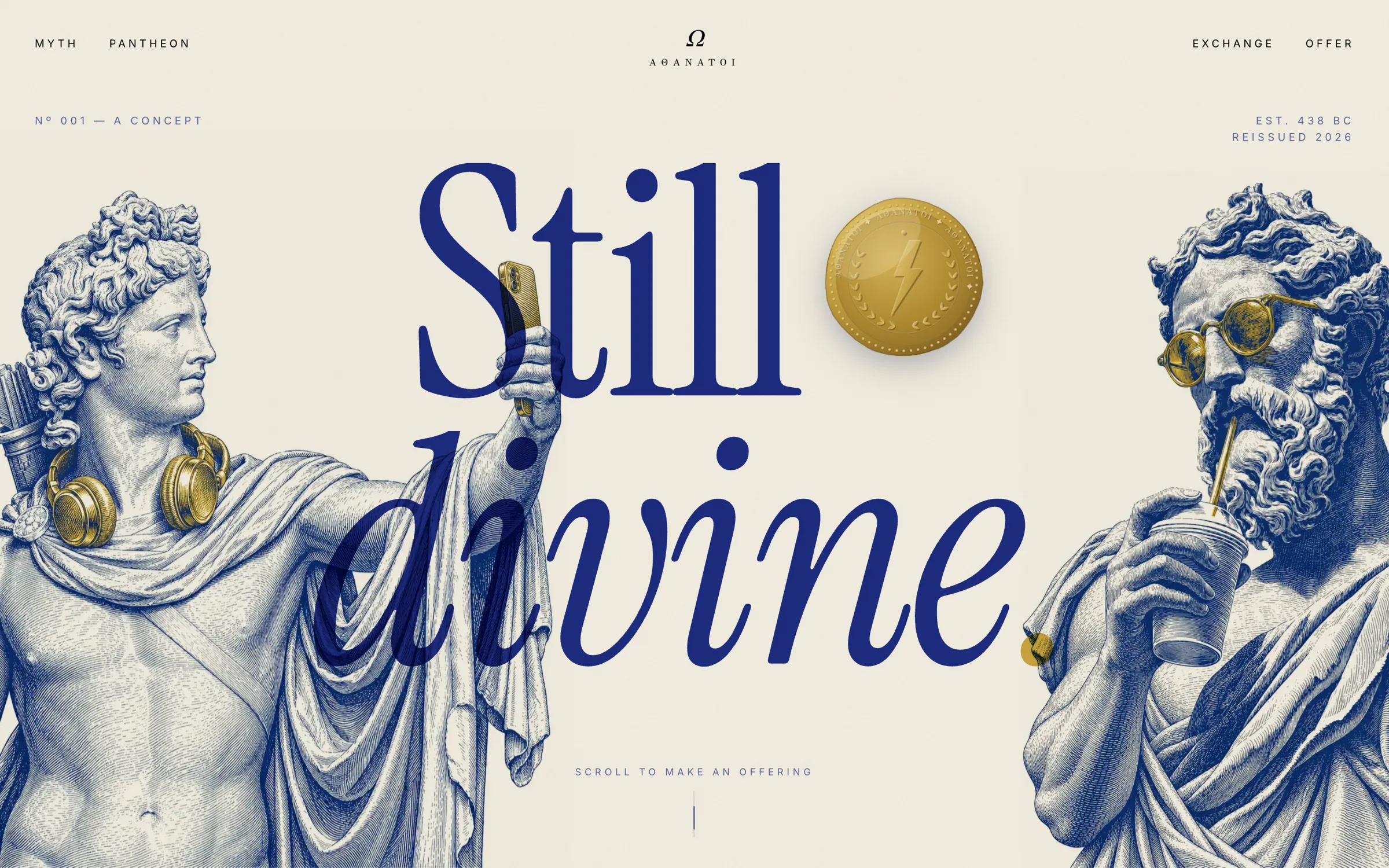
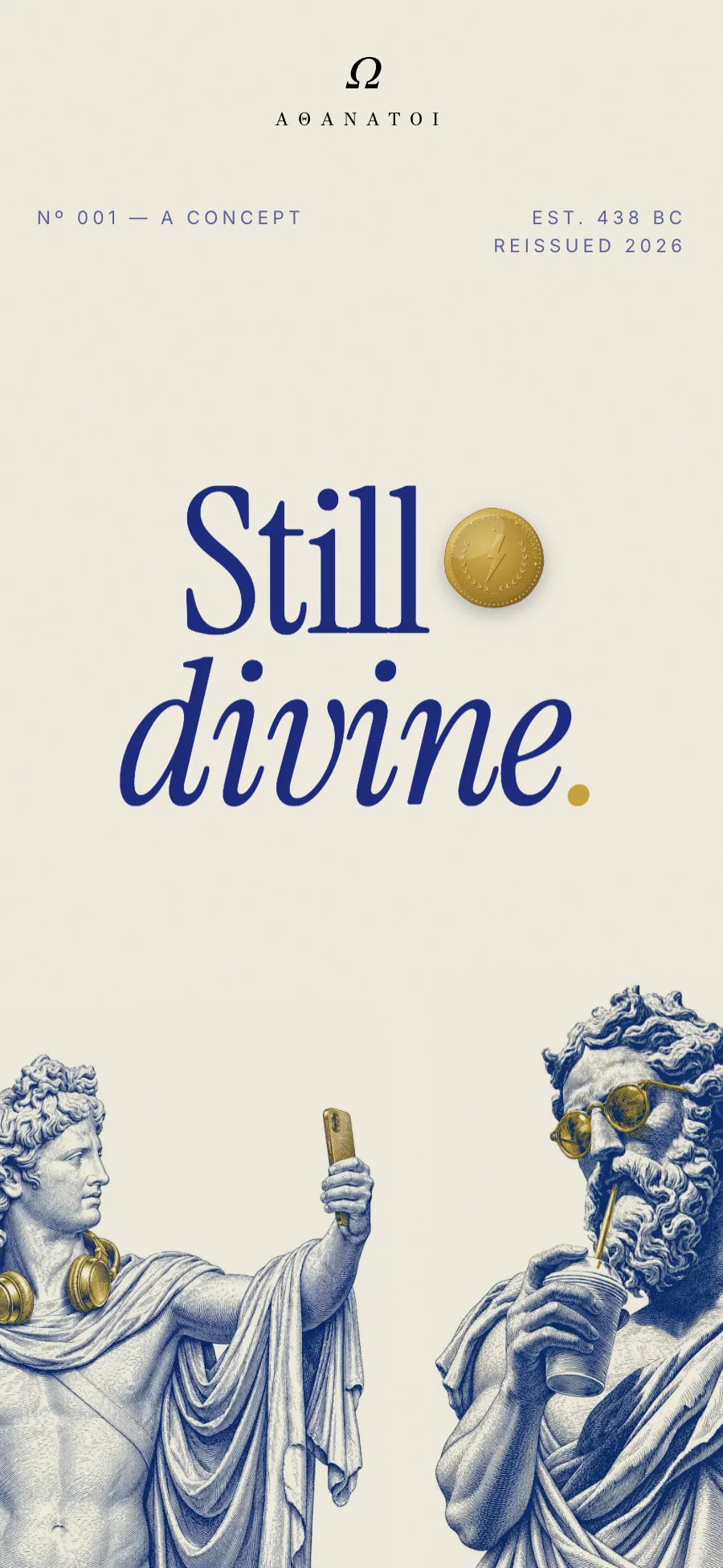
Athanatoi, the immortals, is a story site built on one idea: the Greek gods never died. They were simply out of office, waiting for a new currency of devotion. Now we pay it every day, in attention, and one ancient coin follows you down the page until you decide whether to hand it to the ferryman.
What if the gods never left?
Athanatoi started as a studio question. Most brands ask a website to explain something. We wanted one that tells a story so well people scroll to the end just to see how it finishes, and that makes them laugh along the way.
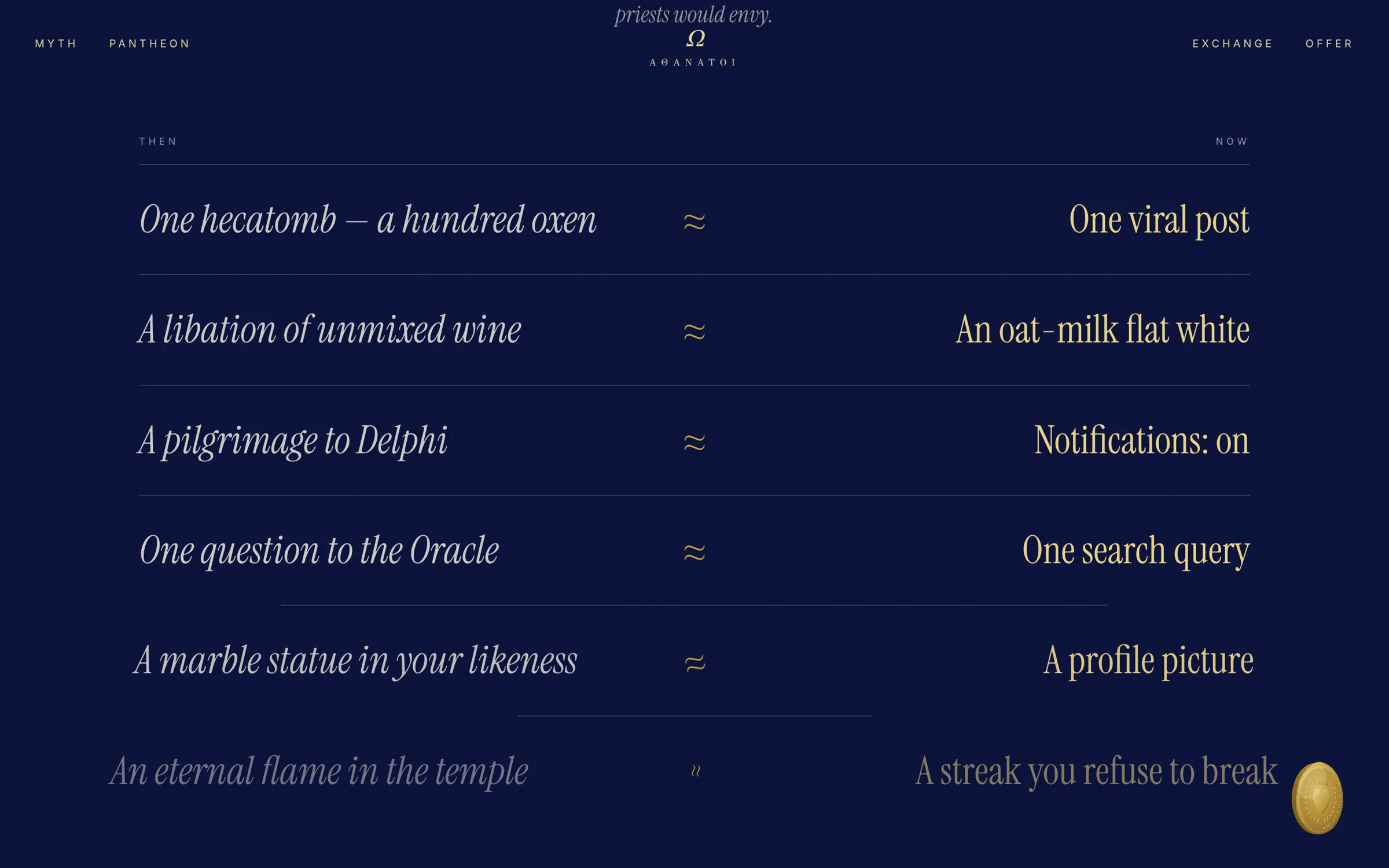
The premise came from the old offerings themselves. The Greeks gave the gods bulls, wine, pilgrimages and marble. We give our phones glances, scrolls, double taps and streaks we refuse to break. Worship was never abolished, the site argues. It was converted, at a rate the priests would envy: a hundred oxen for one viral post, a pilgrimage to Delphi for notifications switched on, a question to the Oracle for a search query.
The look had to sell the joke with a straight face. Every god is a classical engraving in ink blue on warm paper, with only the modern props picked out in gold: headphones, sunglasses, a phone, a lipstick. The type follows the same rule. Instrument Serif carries the headlines, a flowing script is kept for the gods’ own words, and Greek is set in a proper Didot cut, down to the ΑΘΑΝΑΤΟΙ in the navigation and on the coin.
One coin, twenty-four centuries
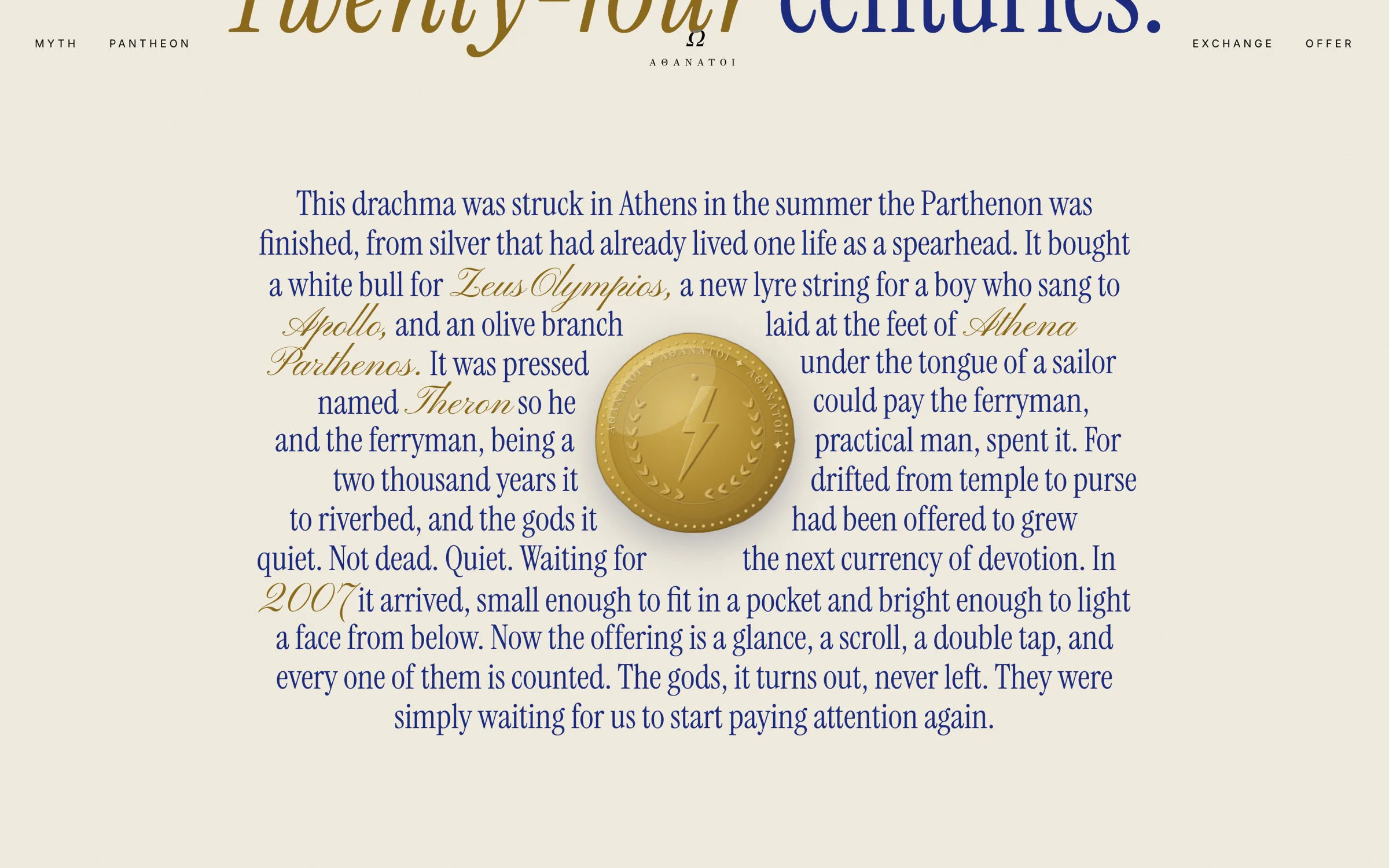
The thread through the whole page is a single obol. It arrives with the hero, spinning down into a slot kept for it in the headline, Still ●, and from then on it never leaves the screen. It is drawn in code rather than photographed: two struck faces with a beaded rim, laurel branches, a thunderbolt on one side and a heart on the other, Greek inscriptions around the edge (ΑΘΑΝΑΤΟΙ, and ΔΩΡΟΝ ΘΕΟΙΣ, a gift to the gods), a patina, and an edge built from fourteen stacked layers so it has real thickness as it turns.
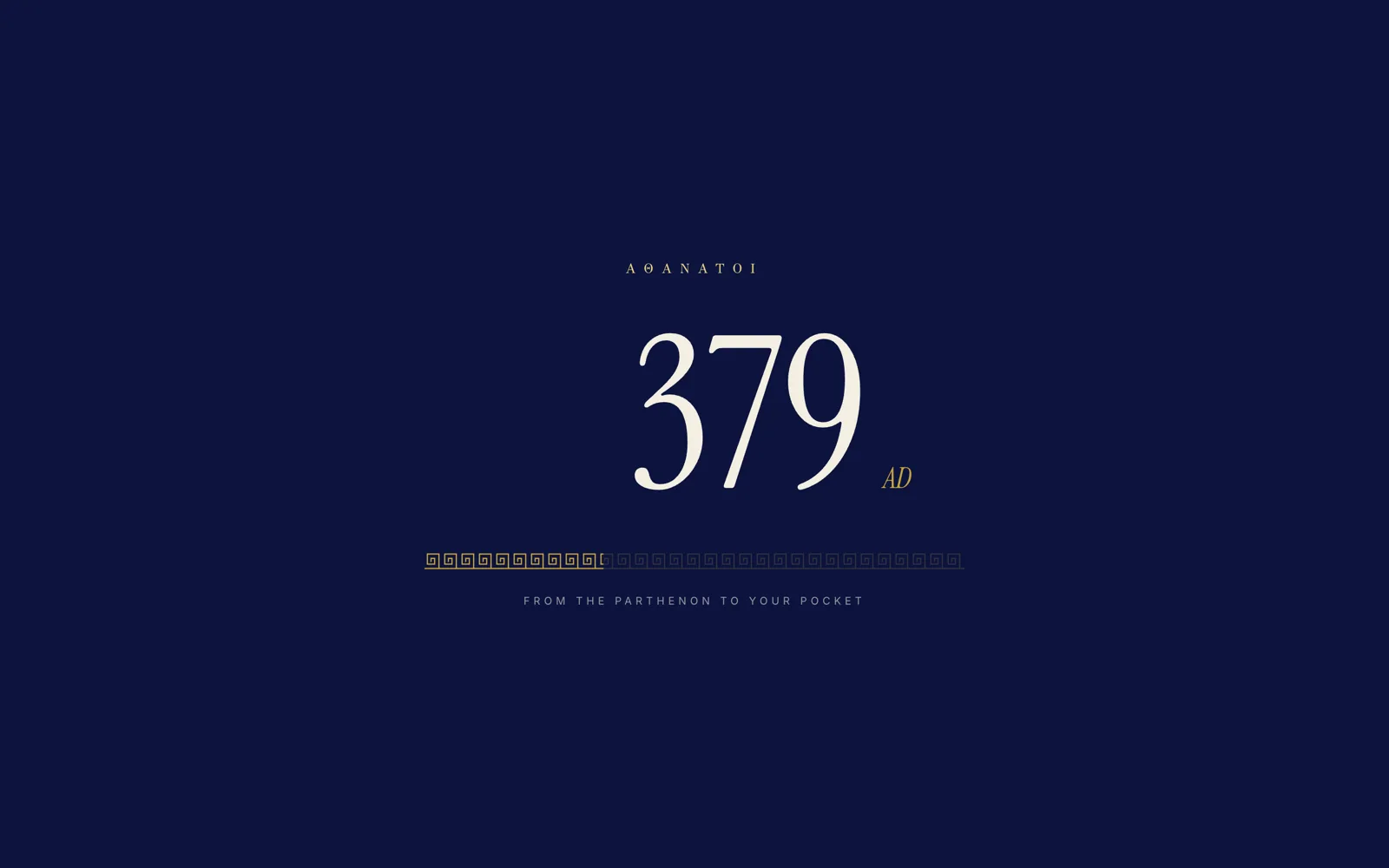
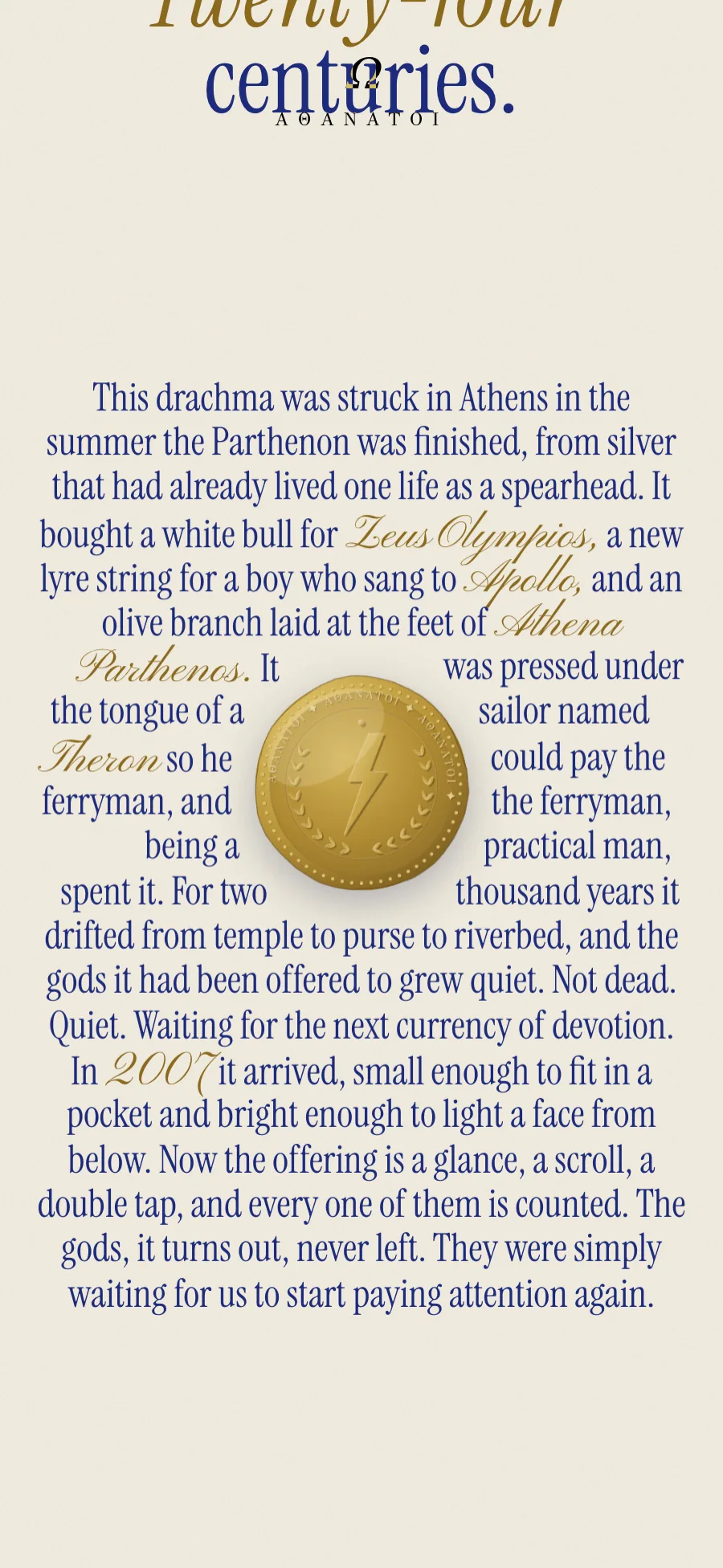
Its story is the first chapter. The coin was struck in Athens the summer the Parthenon was finished, from silver that had once been a spearhead. It bought a white bull for Zeus, a lyre string for a boy who sang to Apollo, and an olive branch for Athena. It was pressed under the tongue of a sailor named Theron so he could pay the ferryman, and the ferryman, being a practical man, spent it. For two thousand years the gods it had been offered to grew quiet. Not dead. Quiet. Until 2007, when the next currency of devotion arrived, small enough to fit in a pocket.
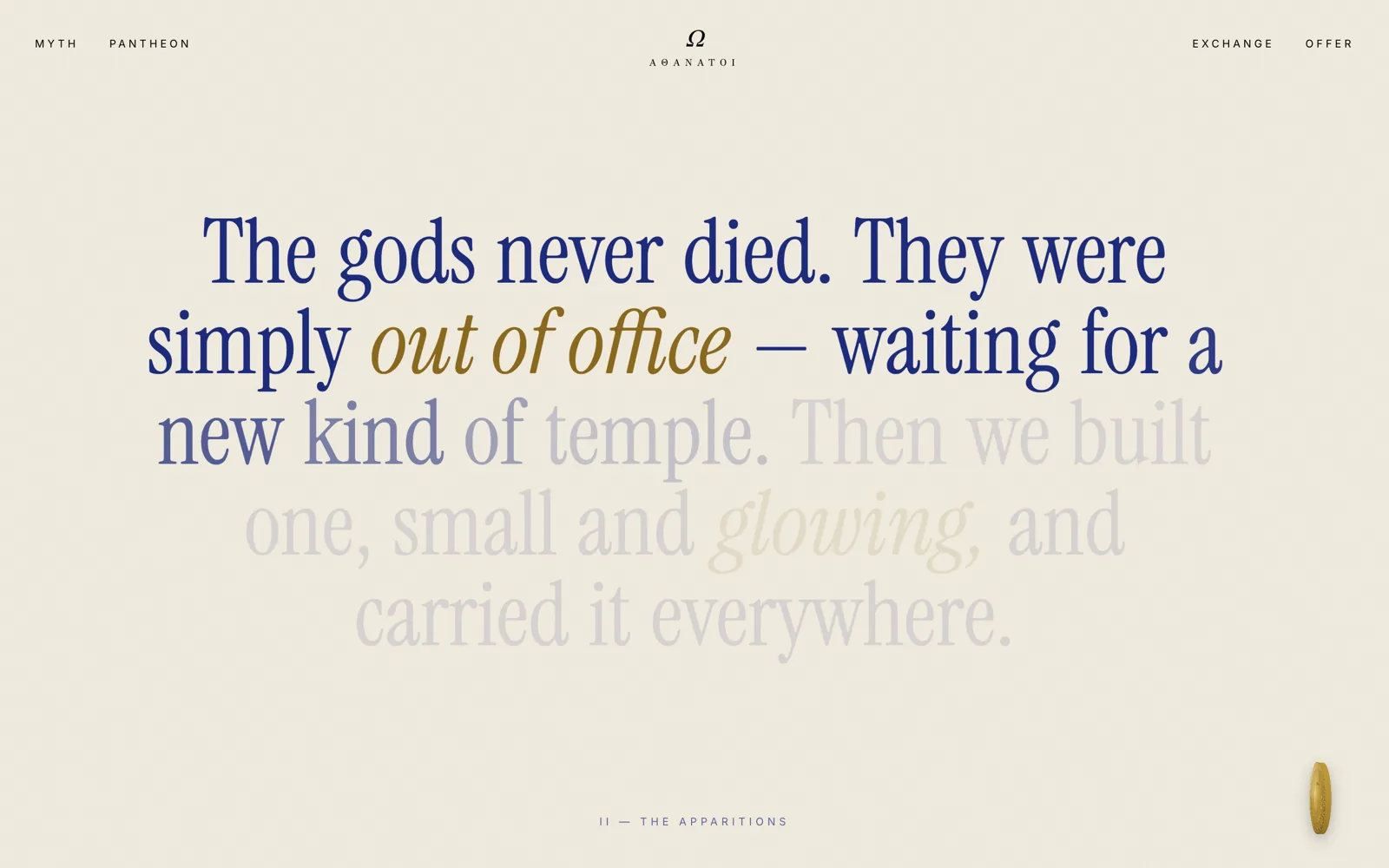
As you read, the coin sits in the middle of the paragraph and the words move out of its way. Every line is laid out again on every frame, so the text parts around the coin, wraps on both sides of it and closes up behind it as it passes. The coin turns with the scroll, leans into fast scrolling and follows the cursor slightly, then parks in the corner of the screen, waiting for the end.
Six gods, reissued for the present day
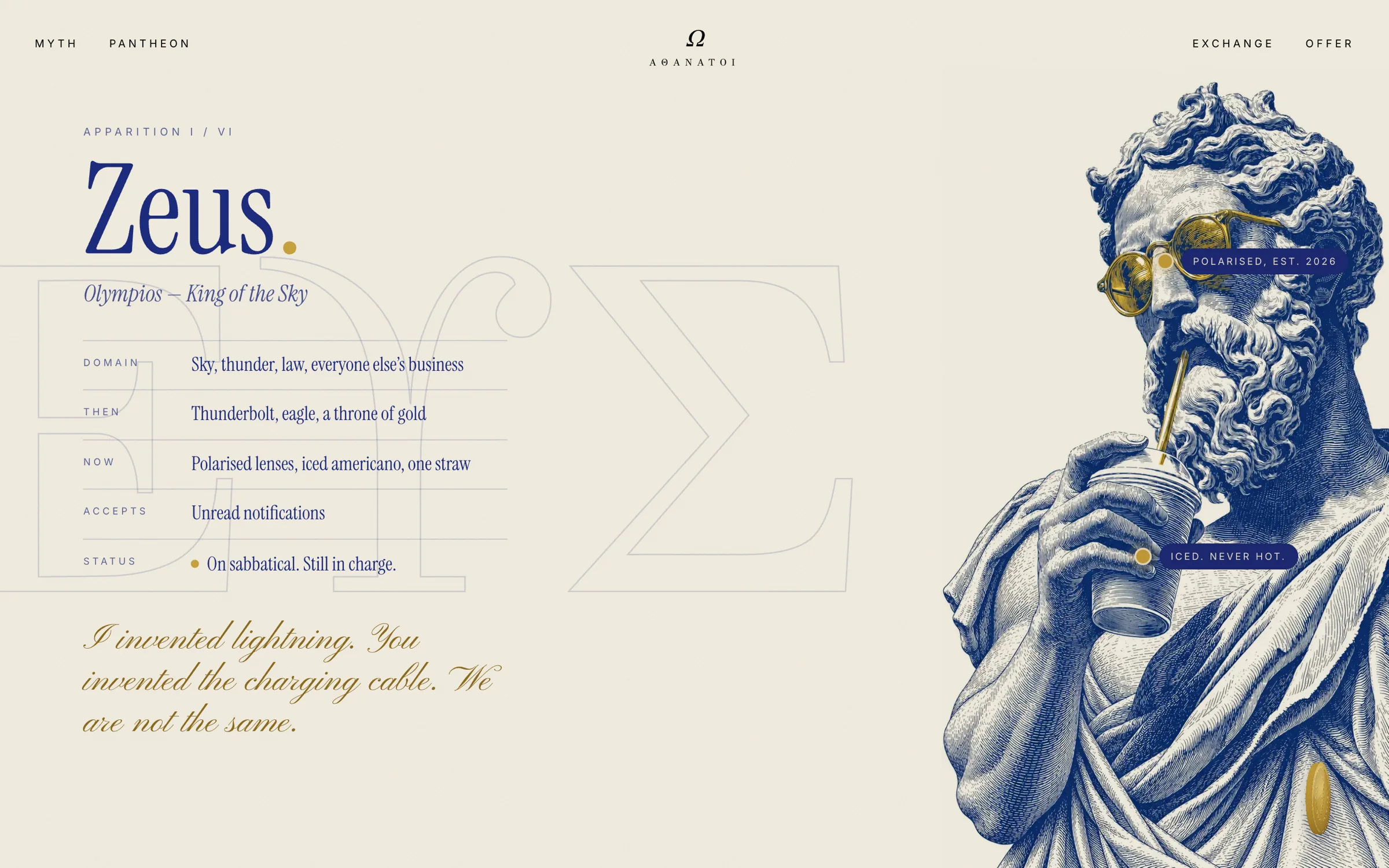
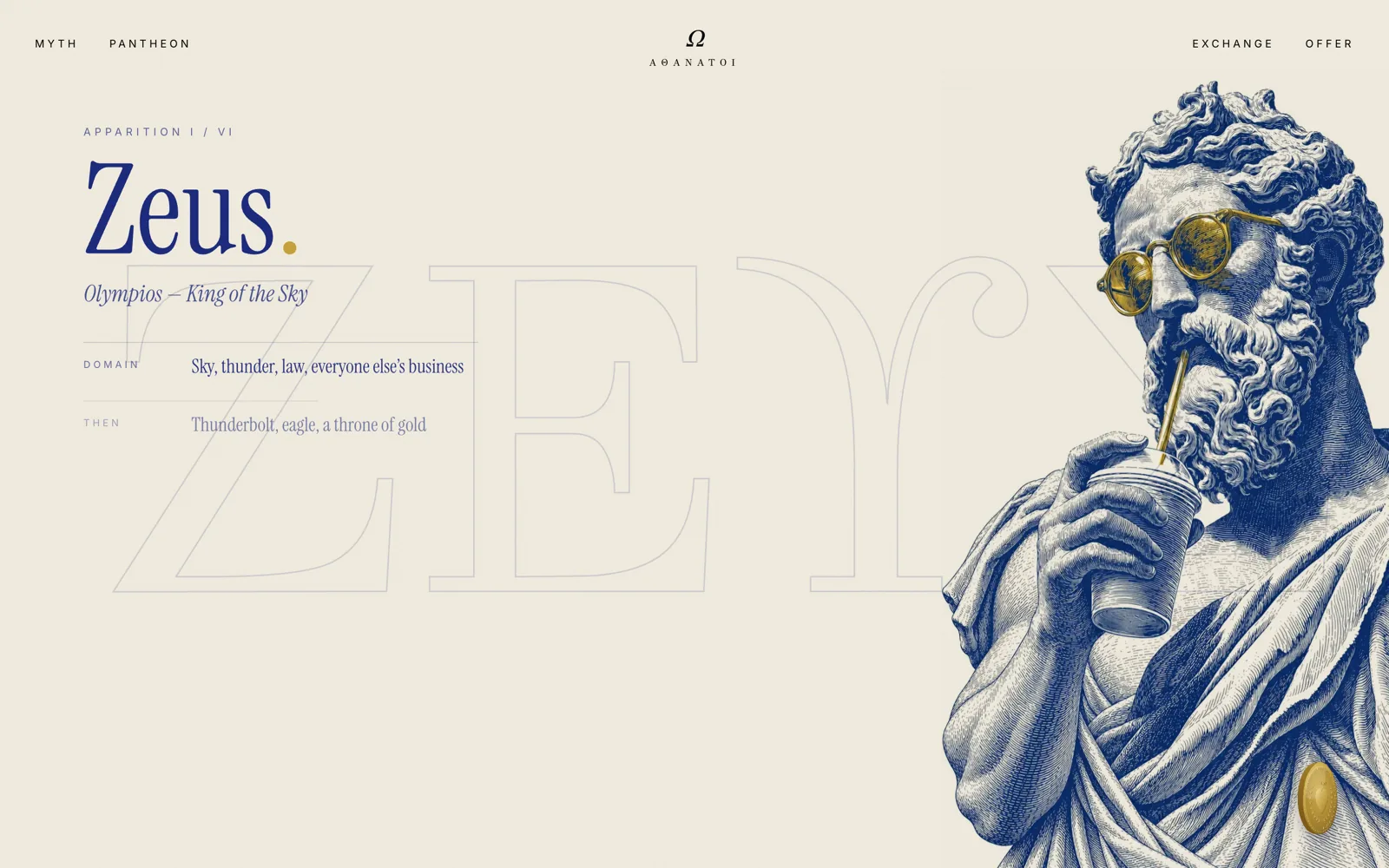
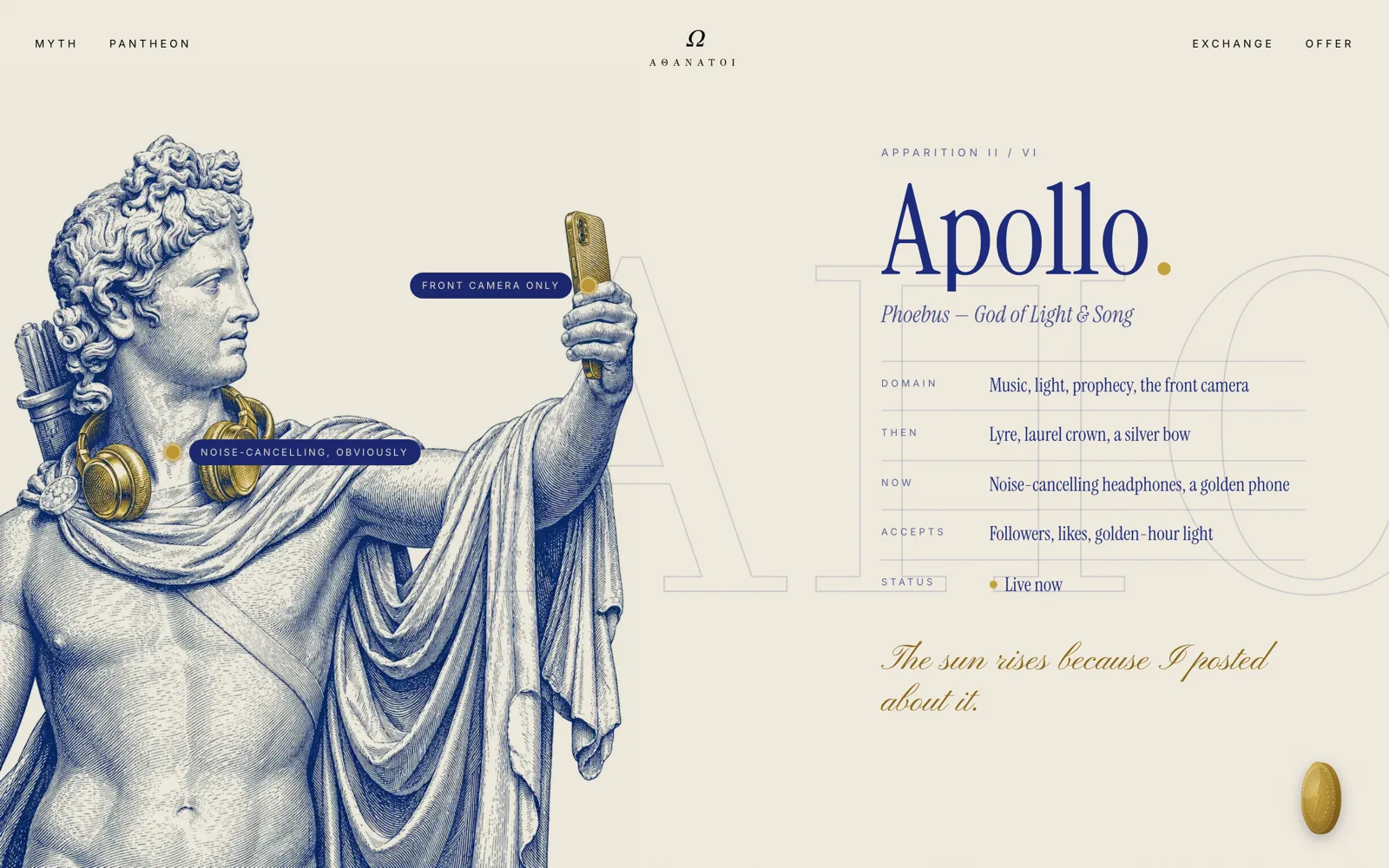
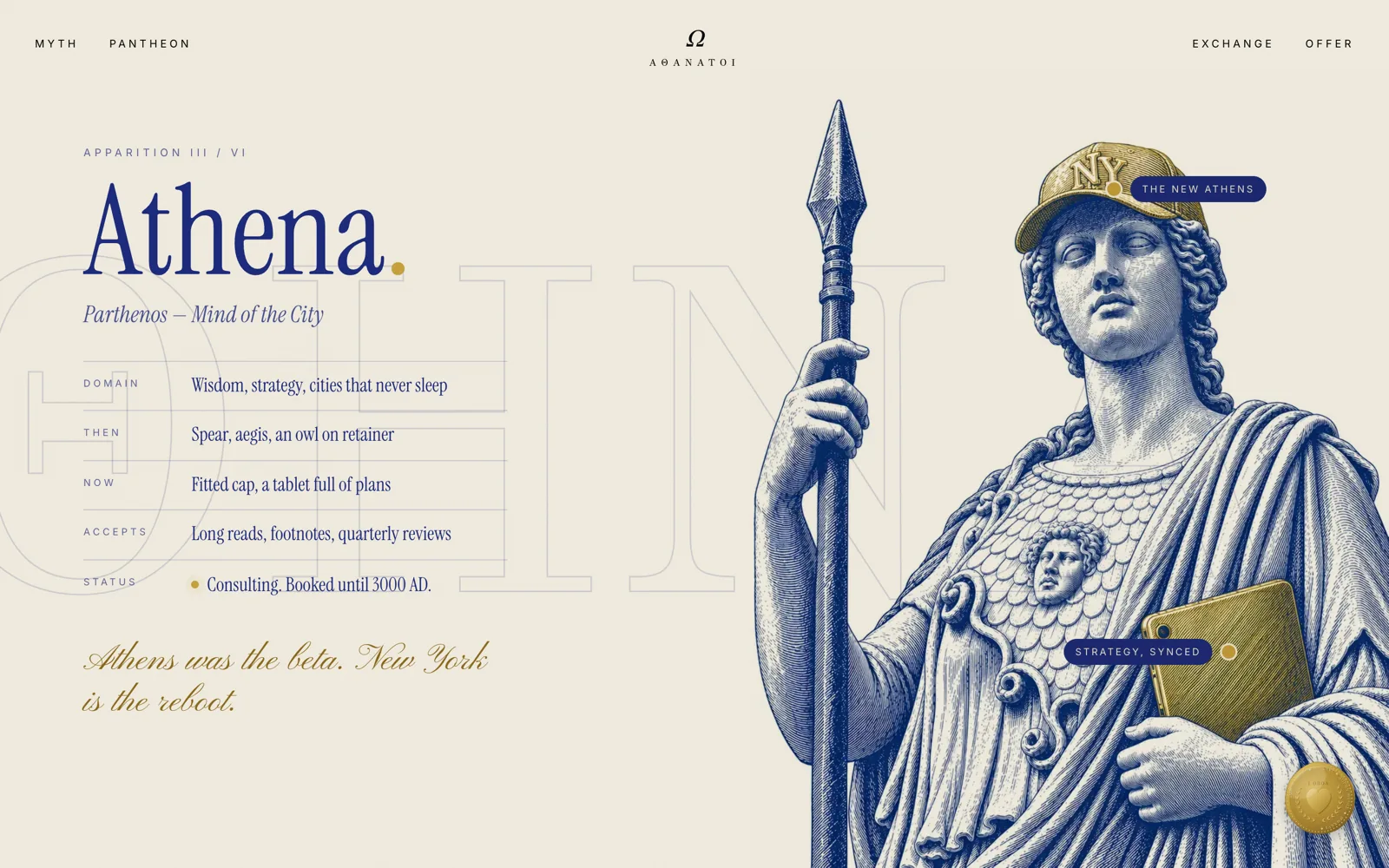
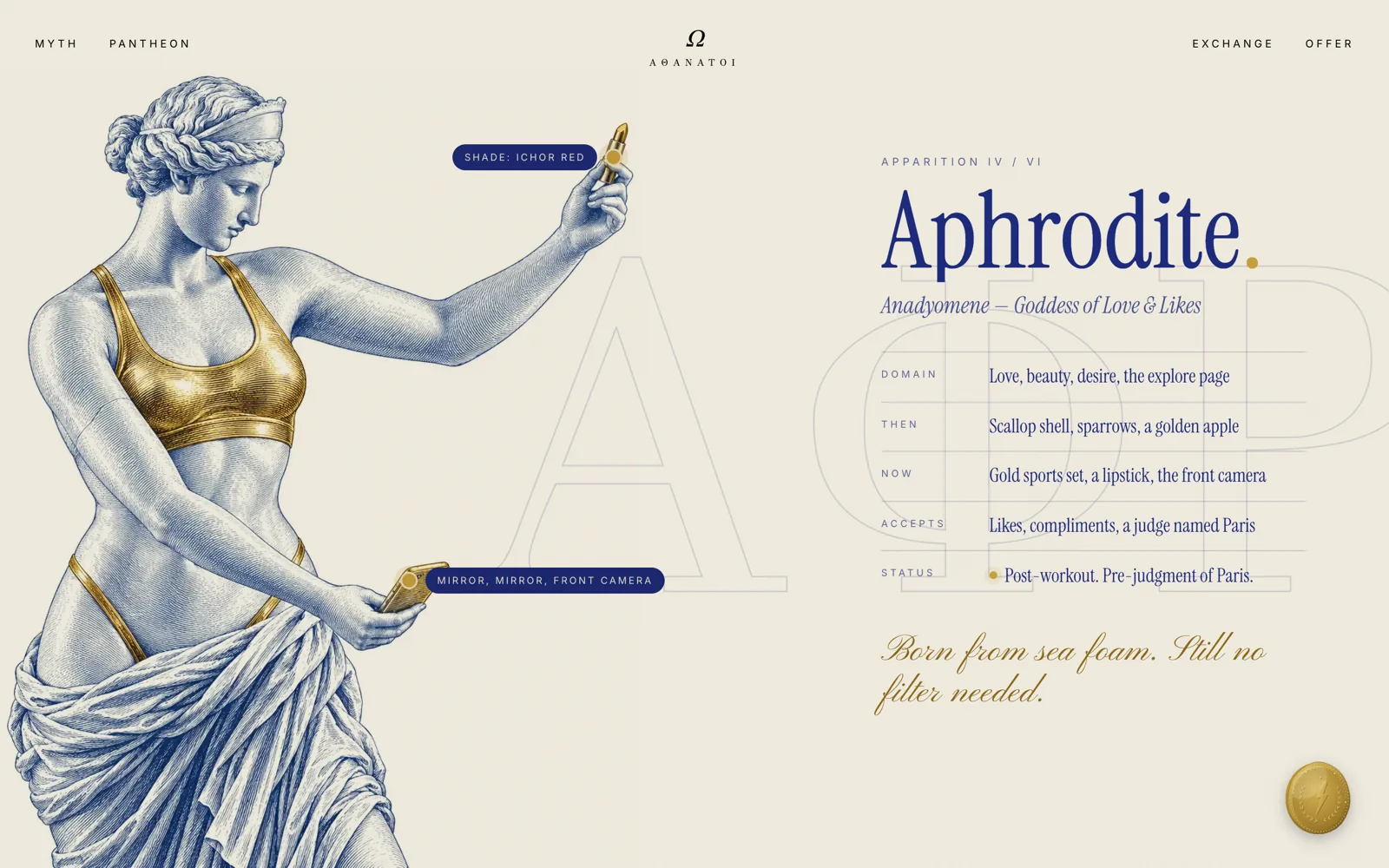
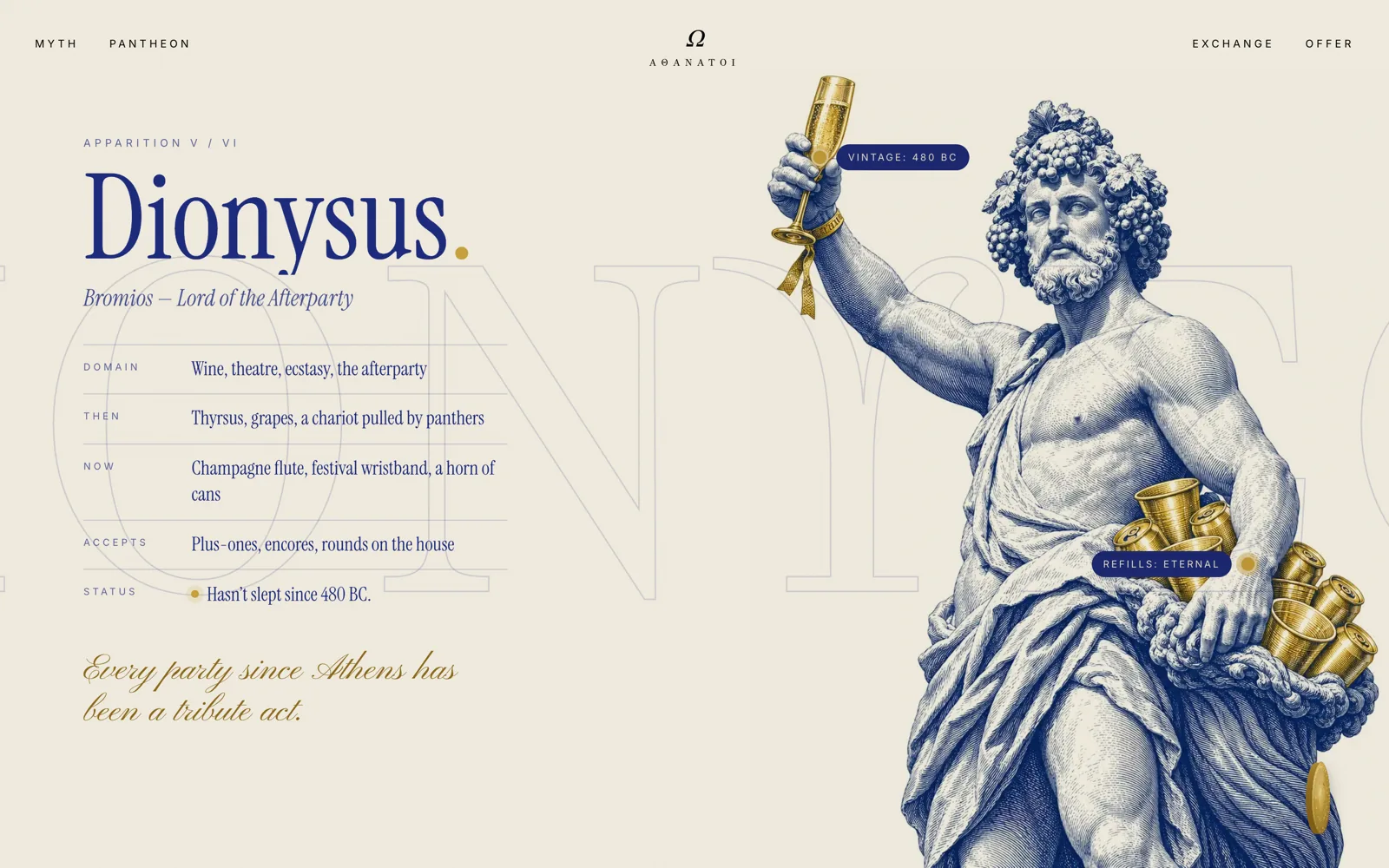
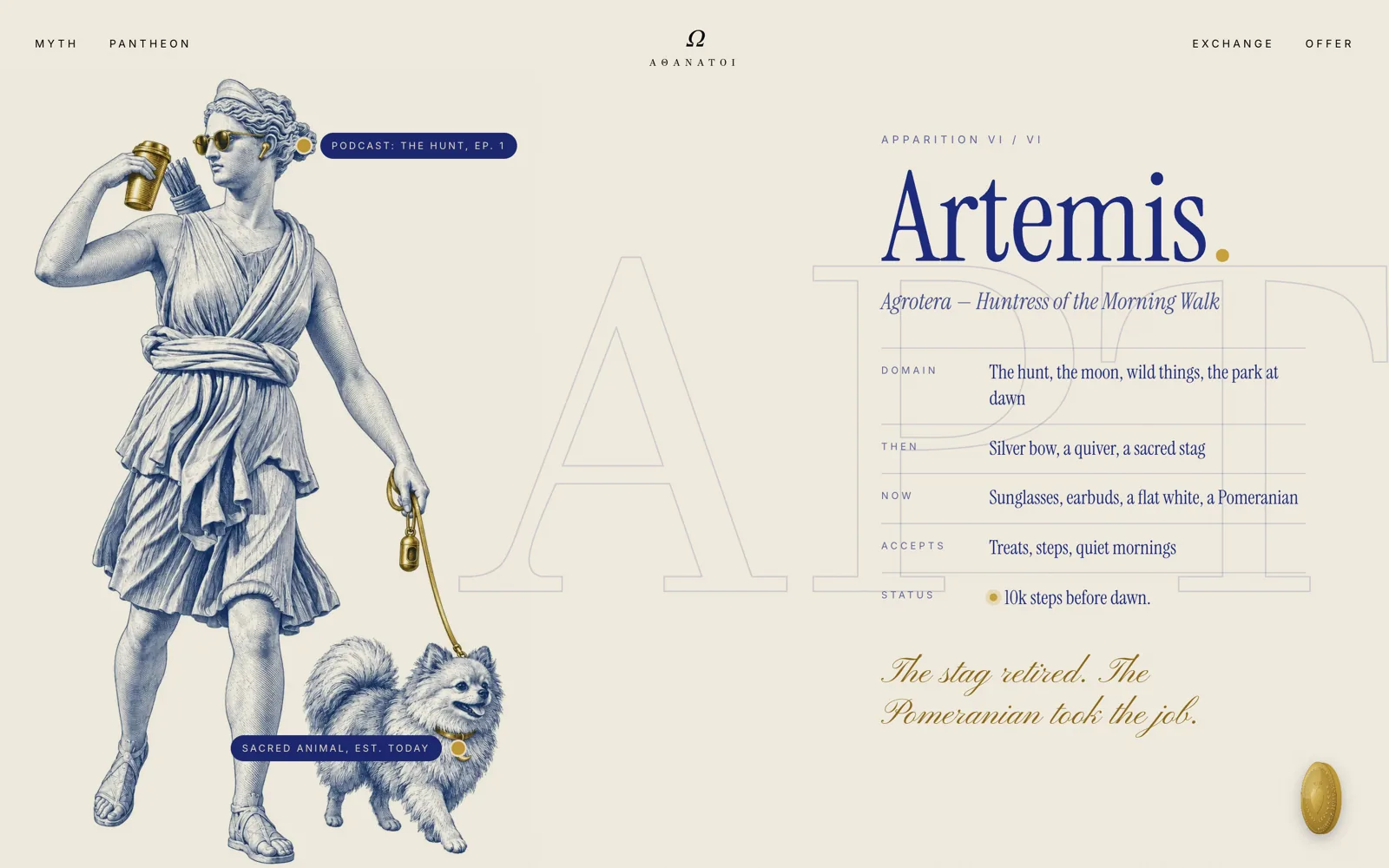
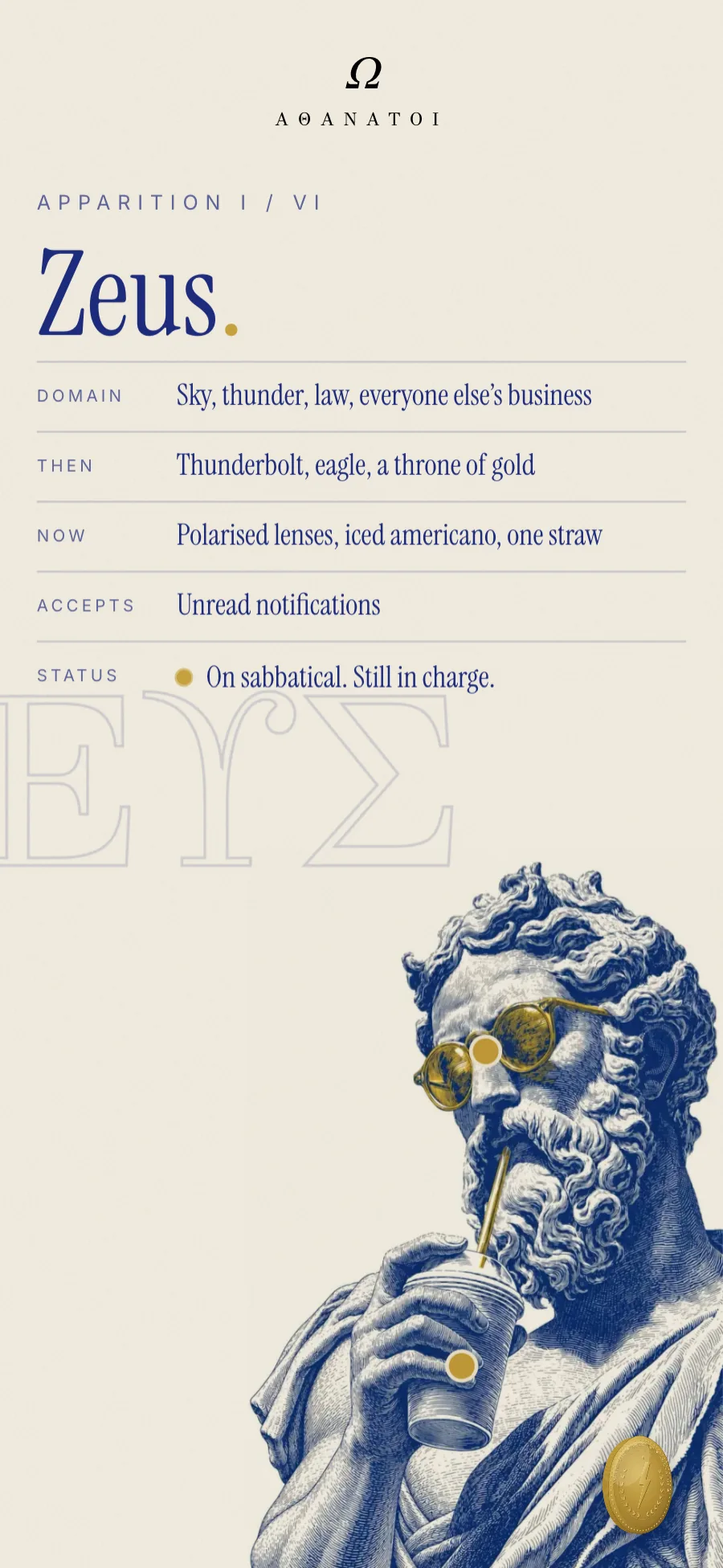
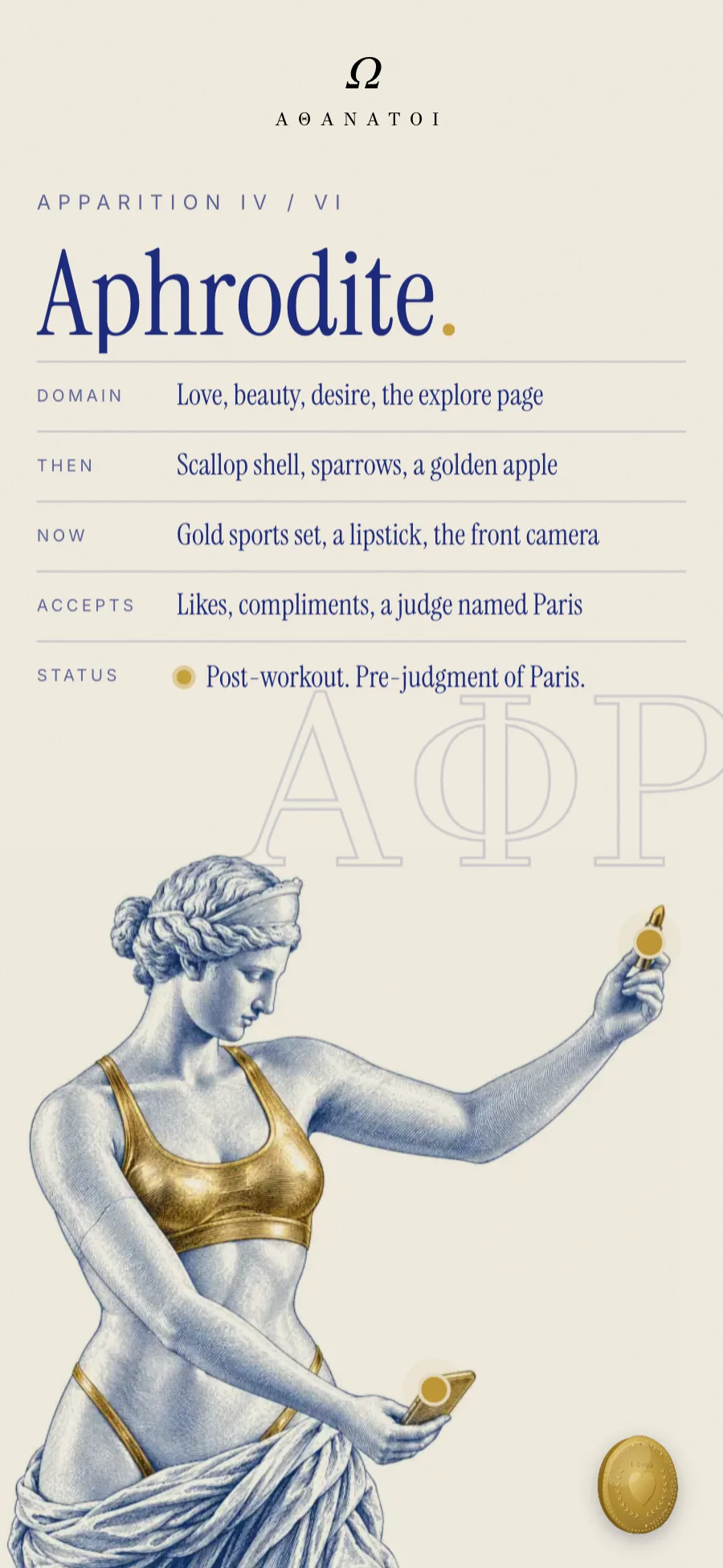
Then the apparitions. Each god gets a full screen, and each one arrives the same way. The statue opens out of a circle that starts on its face, the god’s name in Greek drifts behind it as a huge outlined word, and the name rises letter by letter. Then comes a short profile card: Domain, Then, Now, Accepts and a live status, followed by gold hotspots on the modern props and a line from the god in their own handwriting.
Zeus is on sabbatical but still in charge, in polarised lenses with an iced americano and one straw. He accepts unread notifications. Apollo is live now, with noise-cancelling headphones and a golden phone held for the front camera: the sun rises because he posted about it. Athena has swapped the spear’s owl for a fitted NY cap and a tablet full of plans, and is booked until 3000 AD. Athens was the beta. New York is the reboot.
Aphrodite is post-workout and pre-judgment of Paris, in a gold sports set, with her lipstick in Ichor Red. Born from sea foam, still no filter needed. Dionysus has not slept since 480 BC, raising a champagne flute with a horn full of cans, and is sure every party since Athens has been a tribute act. Artemis does ten thousand steps before dawn with earbuds, a flat white and a Pomeranian. The stag retired. The Pomeranian took the job.
The rest of Olympus is still logging in
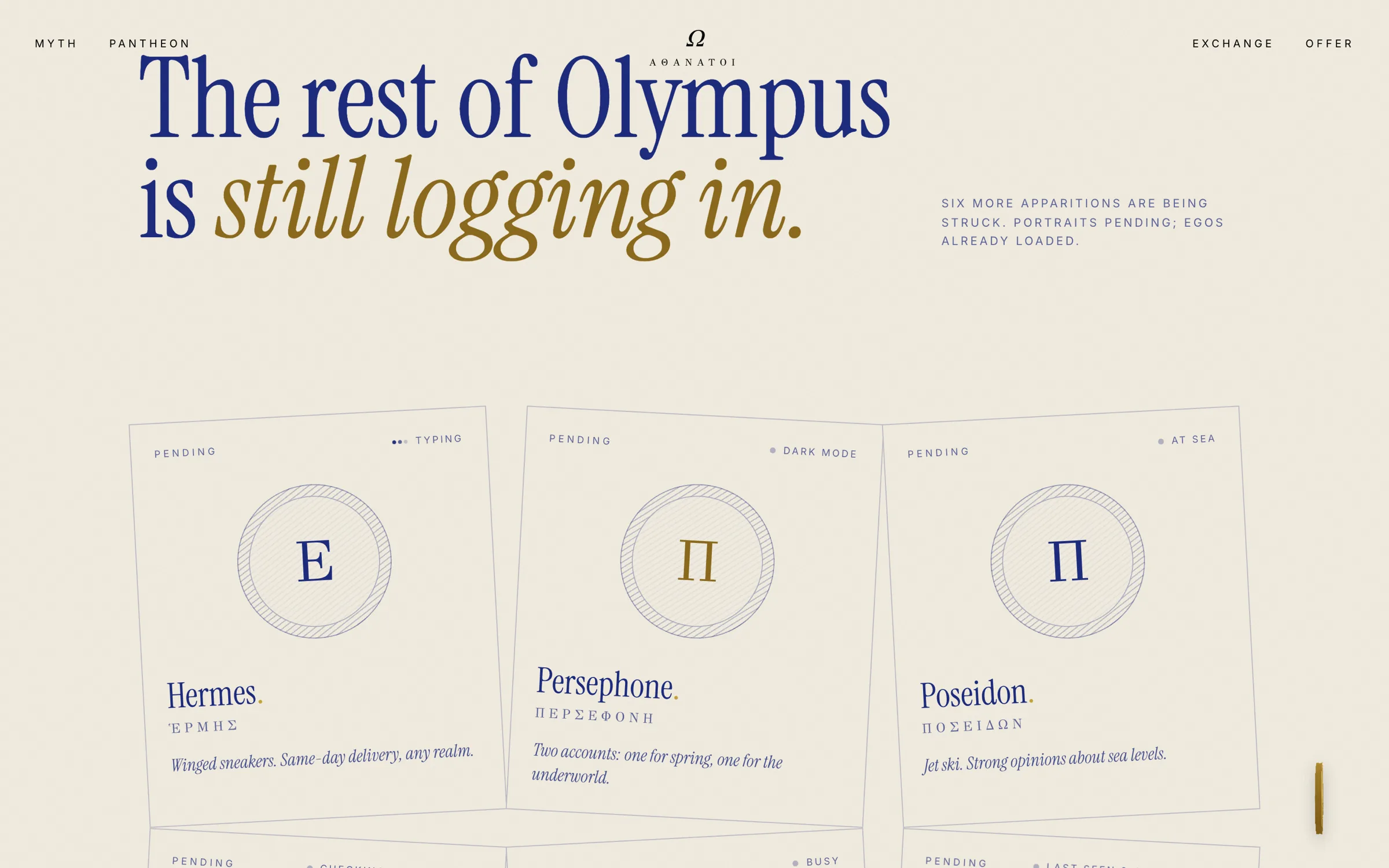
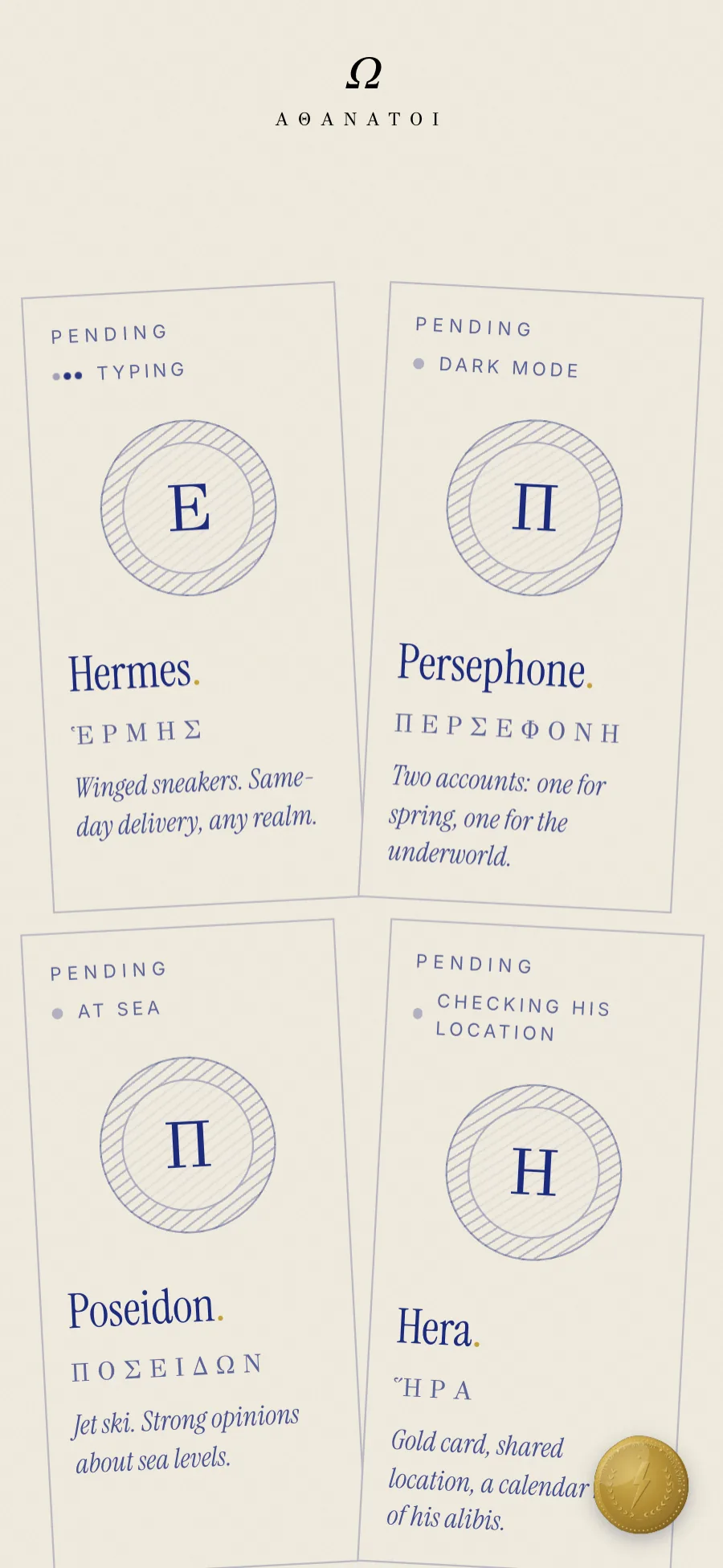
Six gods could never be the whole pantheon, so the rest are on their way, as cards still waiting for their portraits. Each has an engraved medallion with its initial, a one-line update and a status. Hermes is typing, in winged sneakers with same-day delivery to any realm. Persephone keeps two accounts, one for spring and one for the underworld, and is in dark mode. Hera is checking his location. Hephaestus builds everything and gets credited for nothing. Hades has his read receipts off and was last seen 2,400 years ago.
The cards fall into place at slight angles as they scroll in and tilt towards the cursor in 3D, so even a section of placeholders has something to play with.
Pay the ferryman
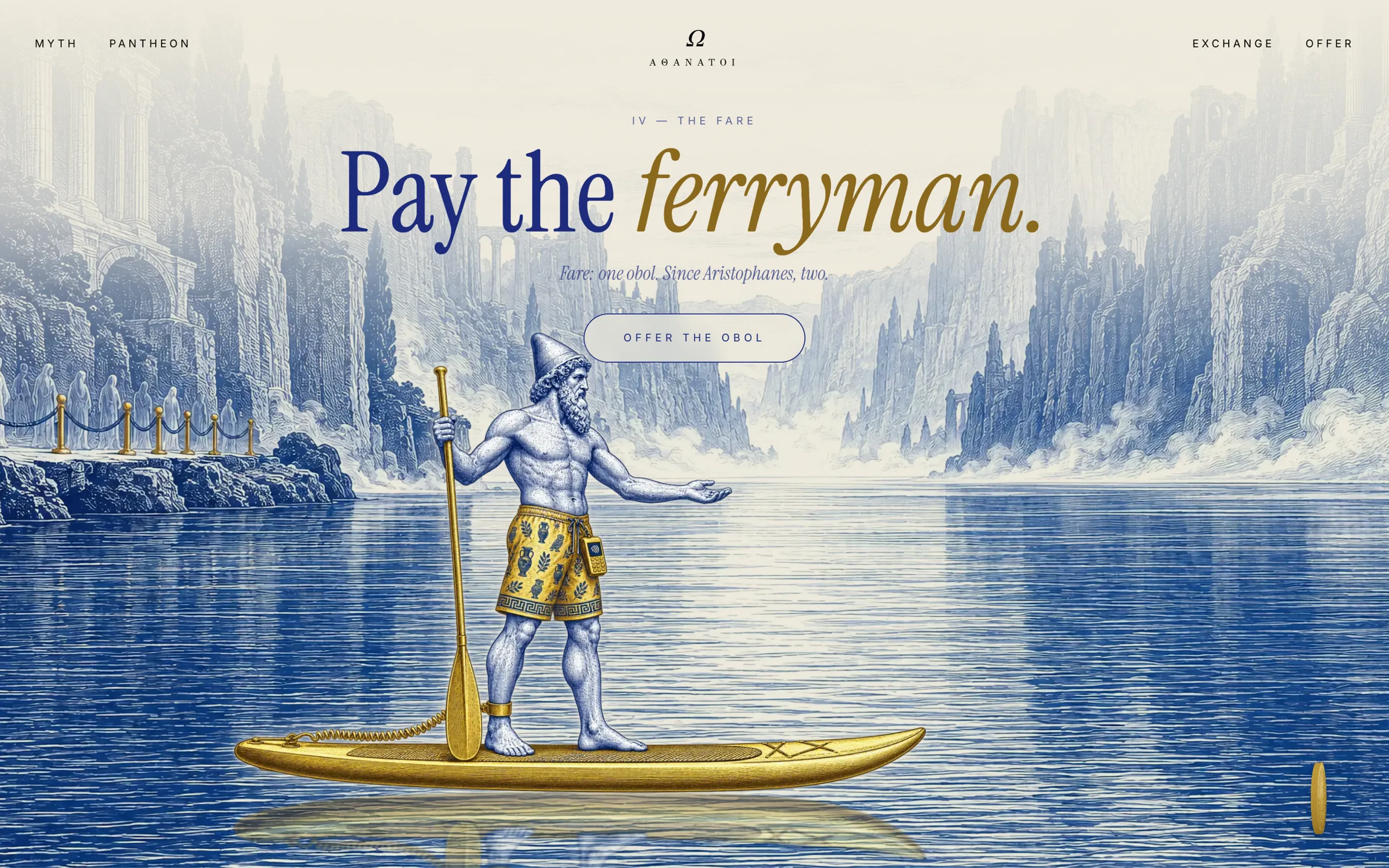
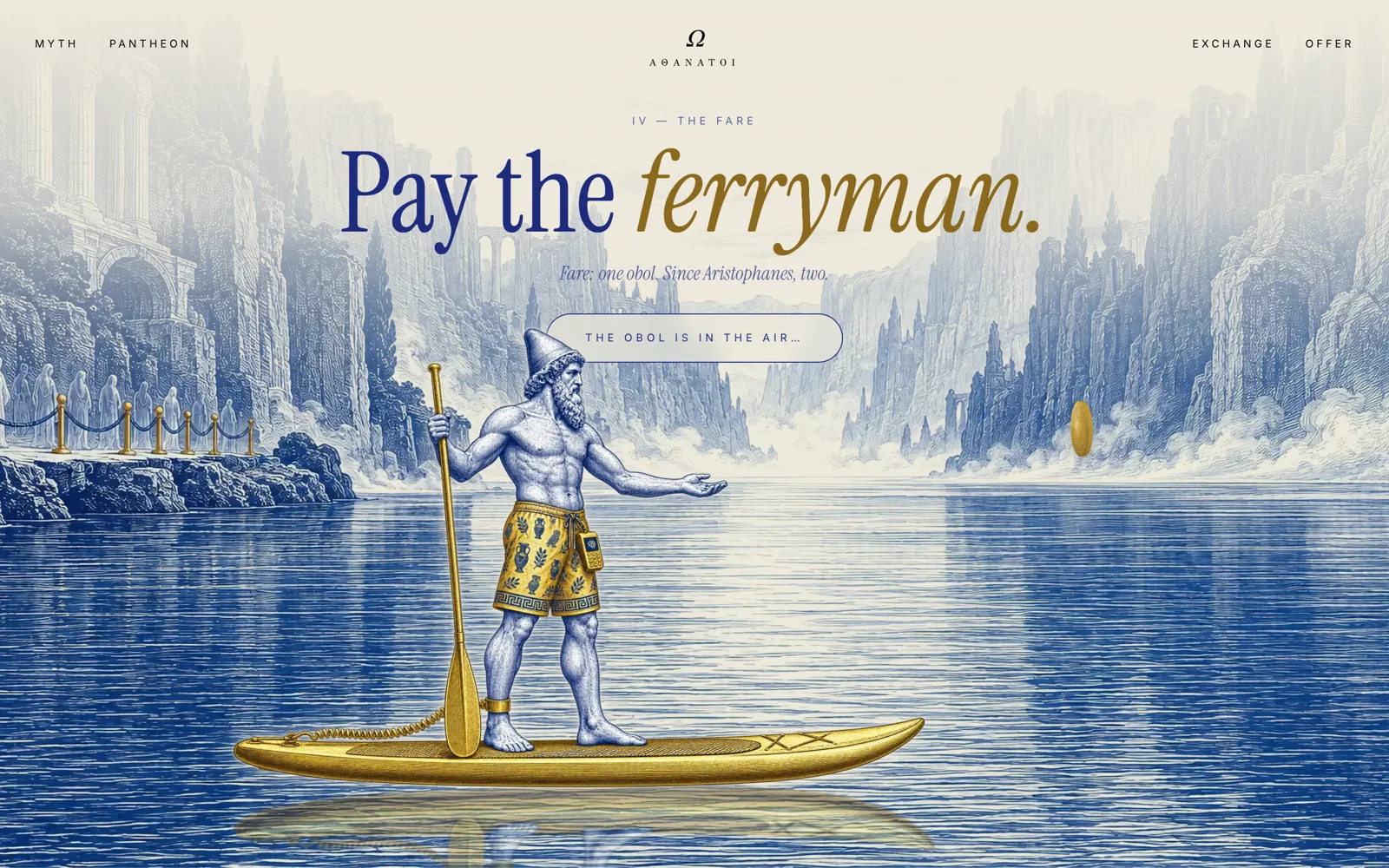
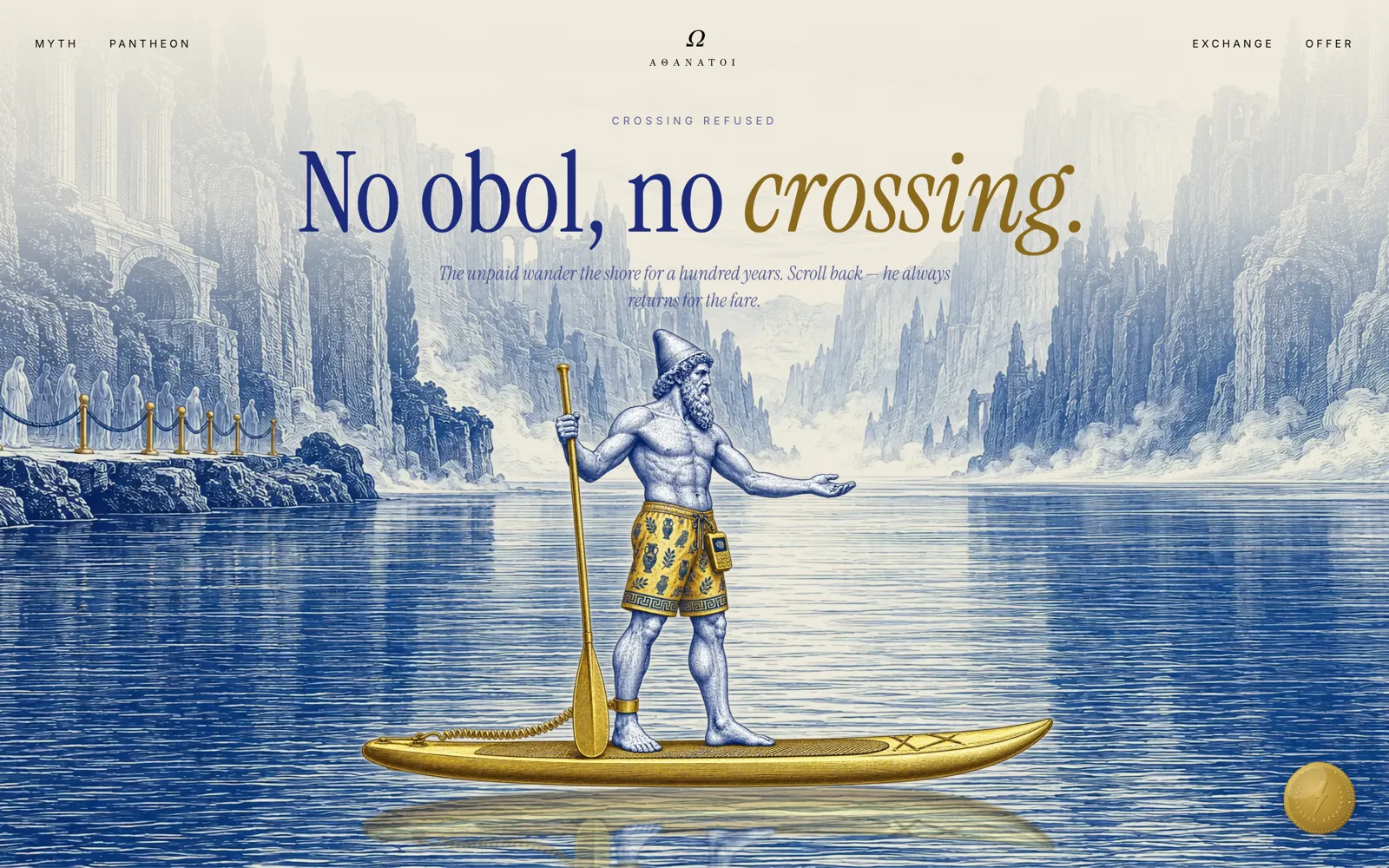
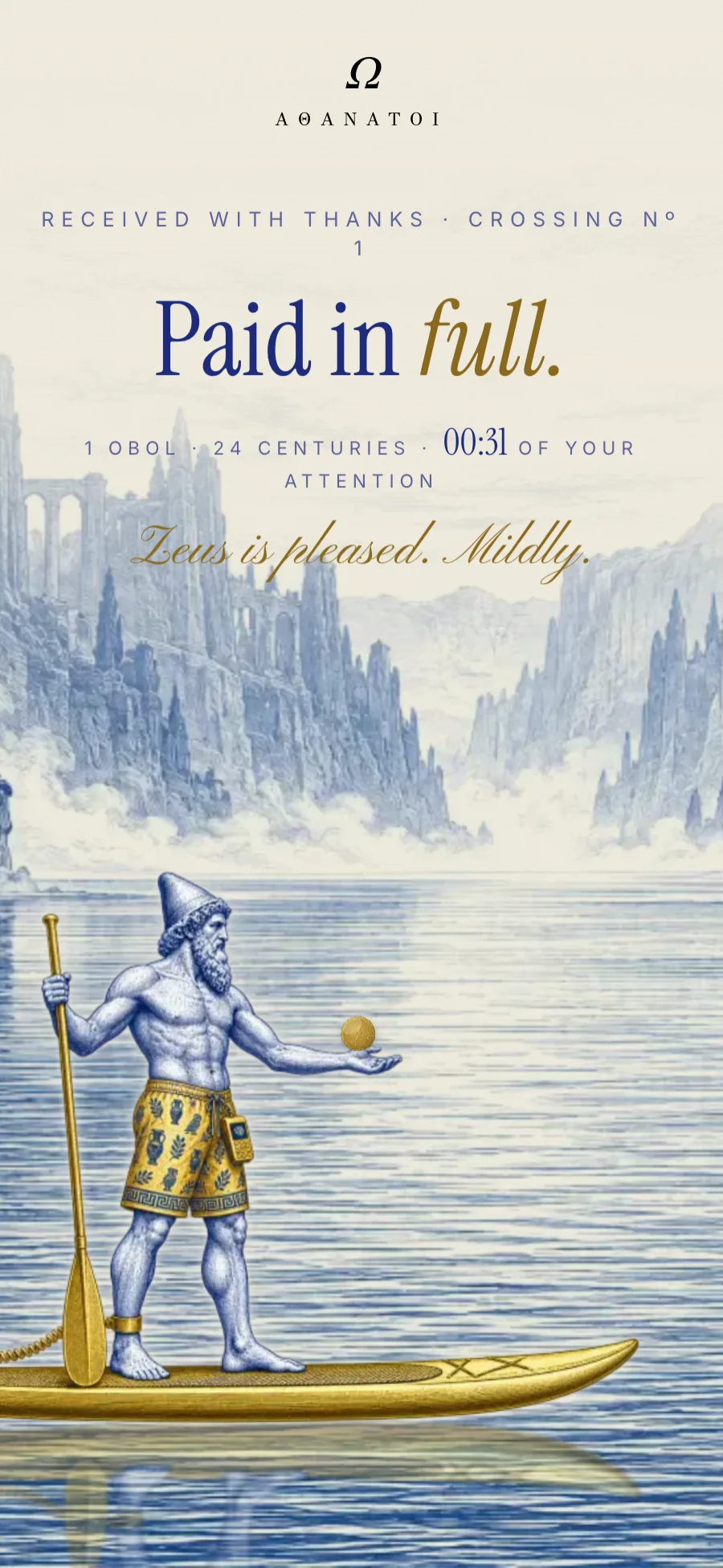
The story ends where the coin’s first life did, on the river Styx. The scene is an engraving of the river between cliffs, and Charon sails in from the left on a golden paddleboard, in patterned board shorts, rocking gently, with his reflection rippling in the water under him. He stops in the middle of the screen with his palm open. Fare: one obol. Since Aristophanes, two.
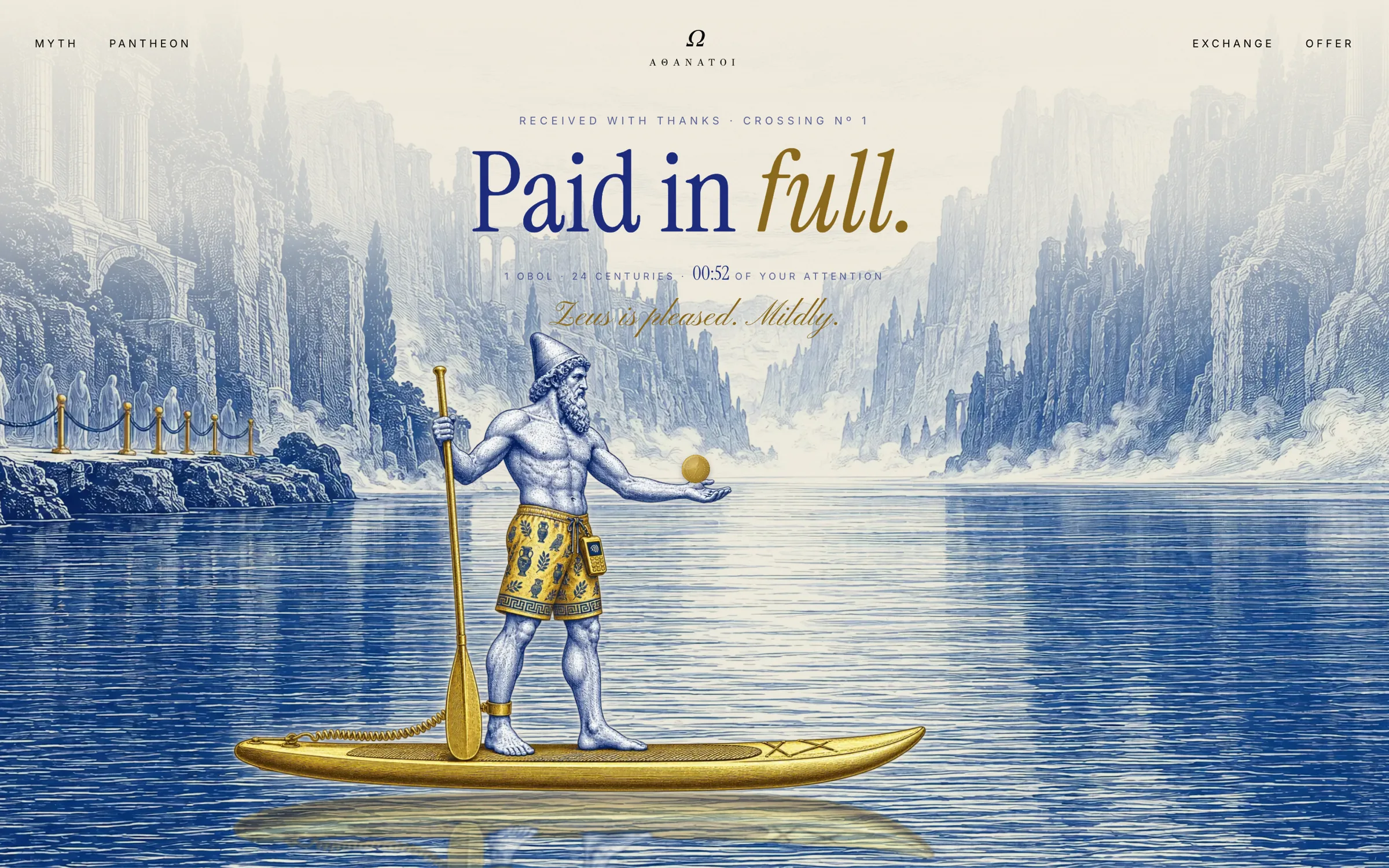
Paying is up to you. Press Offer the obol and the coin that has followed you since the hero leaves its corner, is tossed up in an arc and lands in his hand. It follows his palm exactly as he bobs, and the board dips under the weight before it settles. The receipt reads Paid in full, with your crossing number, the line one obol, twenty-four centuries, and a timer showing how many minutes of your attention the trip took. Then one of the gods replies: Zeus is pleased. Mildly. Apollo reposted your offering. Athena added it to a spreadsheet.
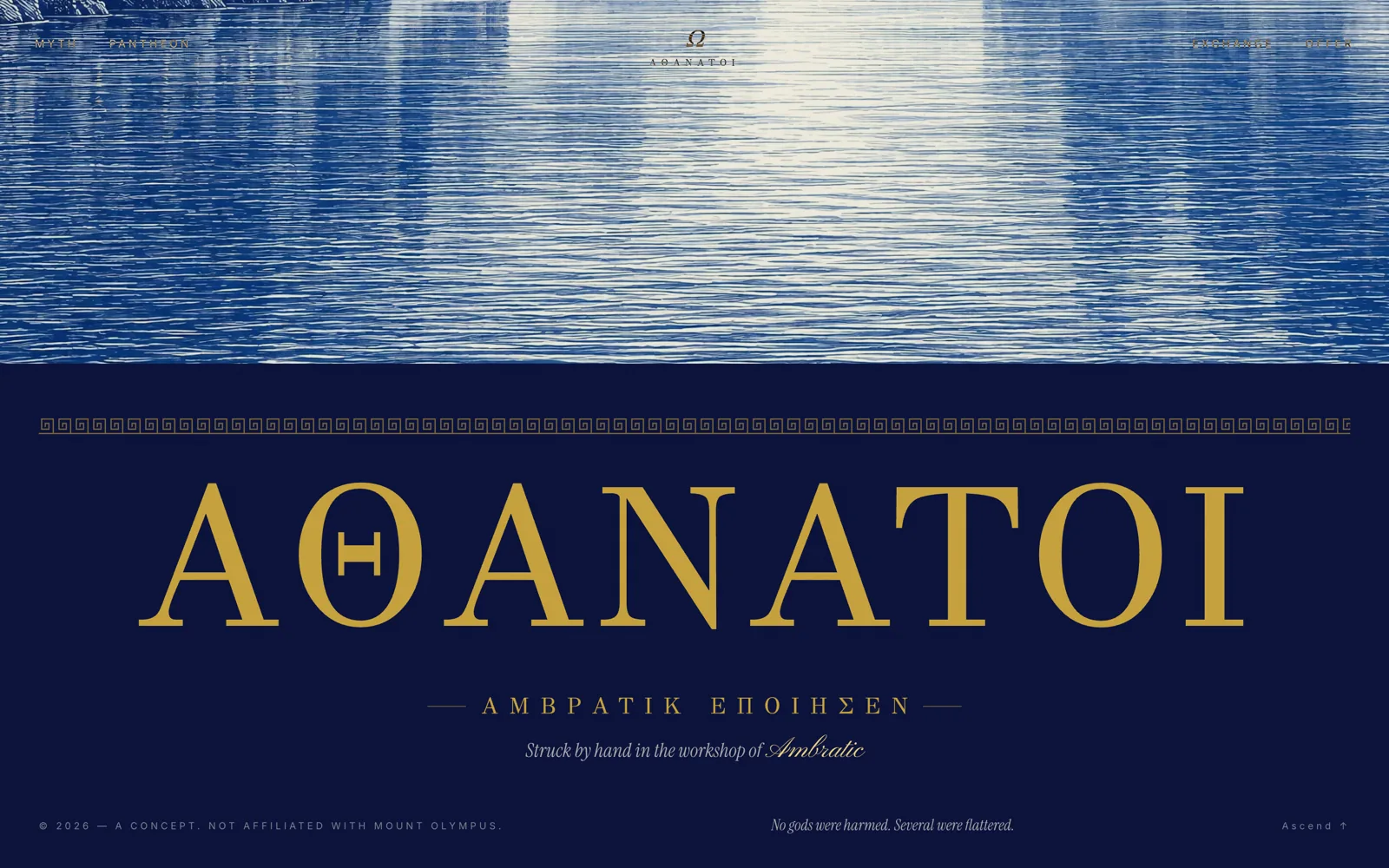
Keep scrolling without paying and Charon sails off without you: No obol, no crossing. The unpaid wander the shore for a hundred years, but scroll back and he always returns for the fare. The page closes on a deep blue footer with ΑΘΑΝΑΤΟΙ in gold and a maker’s mark signed the way Greek potters signed their vases: ΑΜΒΡΑΤΙΚ ΕΠΟΙΗΣΕΝ, Ambratic made me. No gods were harmed. Several were flattered.
Making one coin travel a whole page
Under the jokes, Athanatoi is one continuous scroll animation across more than twenty screens. Most of the engineering went into keeping the coin, the text and the scenes in step without the page ever feeling heavy.
Text that makes room for a moving coin
Browsers cannot wrap text around a shape that moves. So the paragraph is measured word by word once, in its real fonts, and laid out by hand on every frame: each line checks whether it crosses the coin’s circle and, if it does, splits into a part to the left and a part to the right. The page is only touched when the layout actually changes, and the work stops entirely when the paragraph is off screen.
One coin, one route through the page
There is only ever one coin. It sits fixed over the page and follows a route of stops measured from the real sections: the slot in the headline, beside the chapter title, the centre of the story, the corner. When fonts load or the window resizes, the route is measured again. When you pay, the route blends into Charon’s live palm, so the coin rides his bobbing instead of landing on a point he has already left.
A hero that paints fast behind a preloader
The hero statues rise into place rather than fading in, because an invisible image does not count as painted, and a fade held the page’s first big paint until the intro ended. Zeus waits for Apollo to load so the two never split a slow connection, and the preloader covers that moment anyway. Fonts are cut to what is used: one weight of Inter, the Greek face with Greek letters only, and the script face left until the story.
Phones and reduced motion
On phones the god chapters are rearranged rather than shrunk: the statue moves under the text, and the profile card takes over from the epithet and the quote further down the scroll. Hotspots open on tap, on whichever side of the dot has room, and the cursor parallax switches off. With reduced motion there is no countdown at all, and the coin still travels the page but never spins.
A concept that sells imagination
Athanatoi shows what we mean by creative work. A single idea carried all the way through: the copy, the illustrations, the coin and the code all tell the same joke, and the visitor gets to deliver the punchline themselves by paying the ferryman.
For clients it is a demonstration of range. The same techniques, a story told through scroll, an object that guides the eye from start to finish, text that reacts to what moves through it, and an ending the visitor chooses, can turn a product launch, a brand story or a campaign into something people finish and remember.
For us, the lesson was that humour needs precision. A joke lands only if the timing is right, and on a page like this the timing is the engineering.
- Performance on desktop
- 100
- Performance on mobile
- 95
- SEO
- 100
- Best practices
- 100
MORE WORK
You might also like
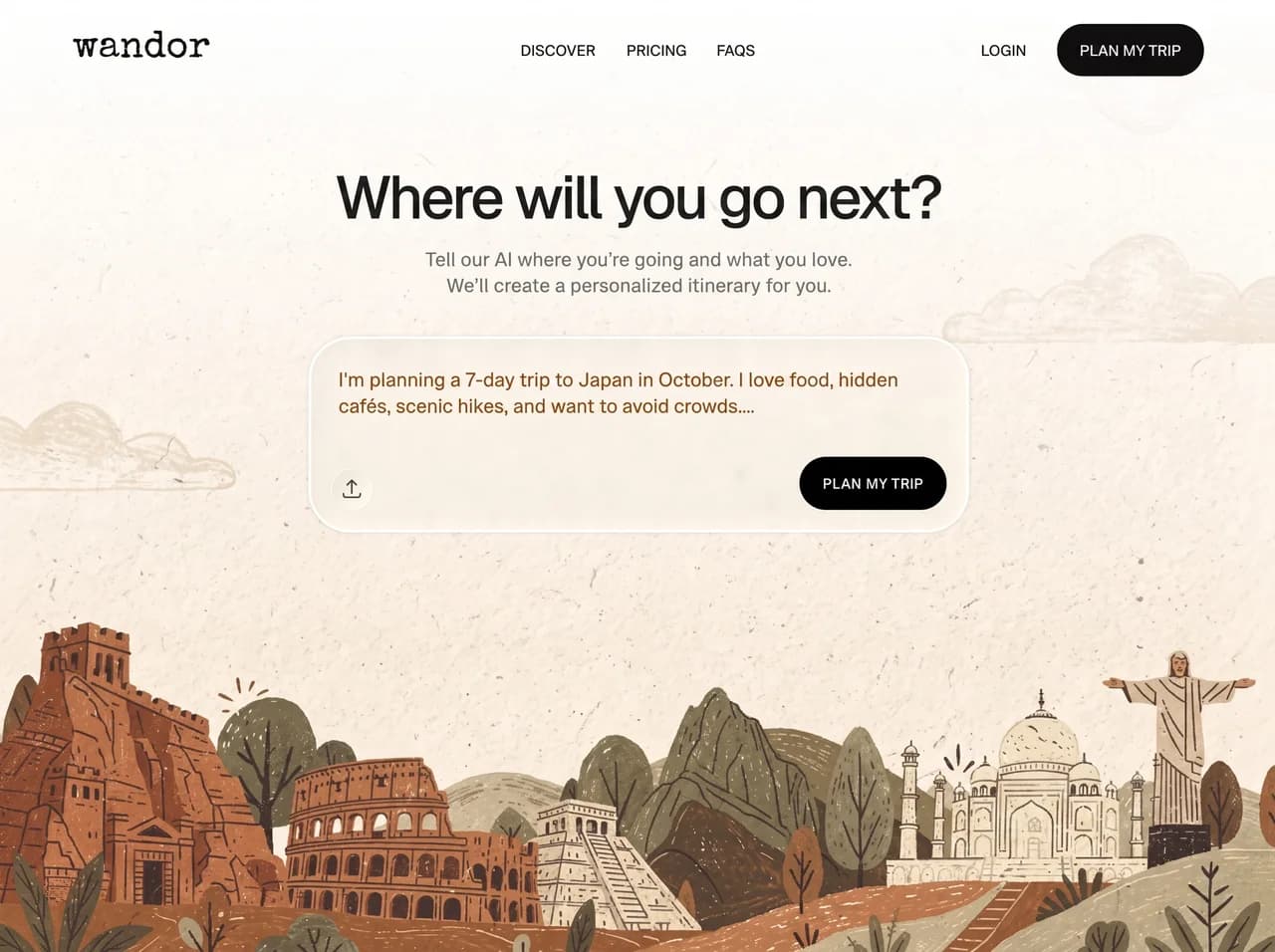
Wandor
AI travel planner that turns where you are going and what you love into a personal itinerary.
- UX/UI
- Branding
- Social Media
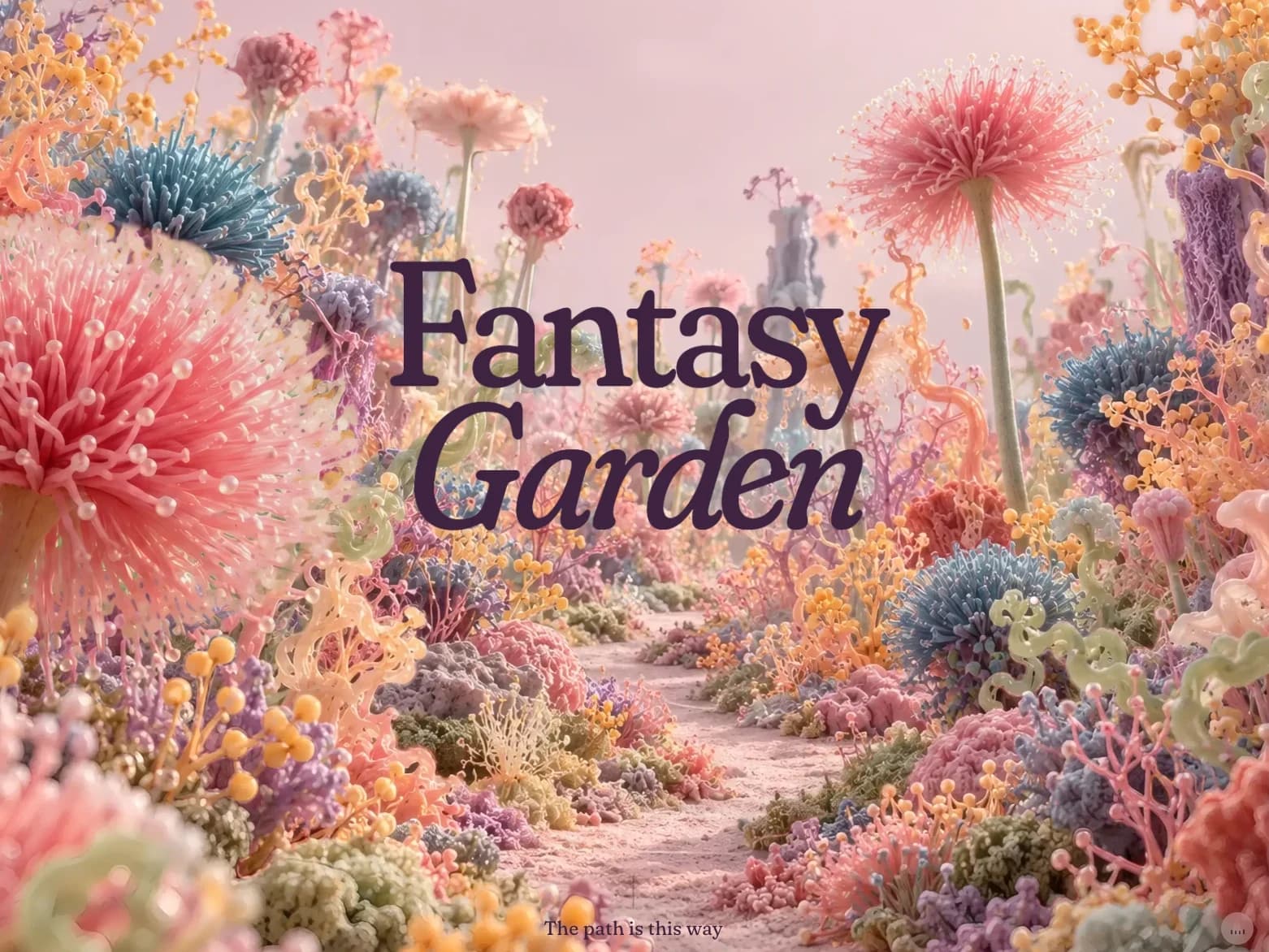
Fantasy Garden
Concept 3D walk through an impossible garden, past flowers we made in Blender that turn, unfurl and hide as you reach for them.
- Concept
- 3D
- Motion