Details
- Client
- Ambratic concept
- Industry
- Sleep & wellbeing
- Product
- Wind-down app, imagined
- Services
- Concept · UX/UI · Website · Motion
- Stack
- Next.js · Canvas · Web Audio · Lenis
- Year
- 2026
Introduction
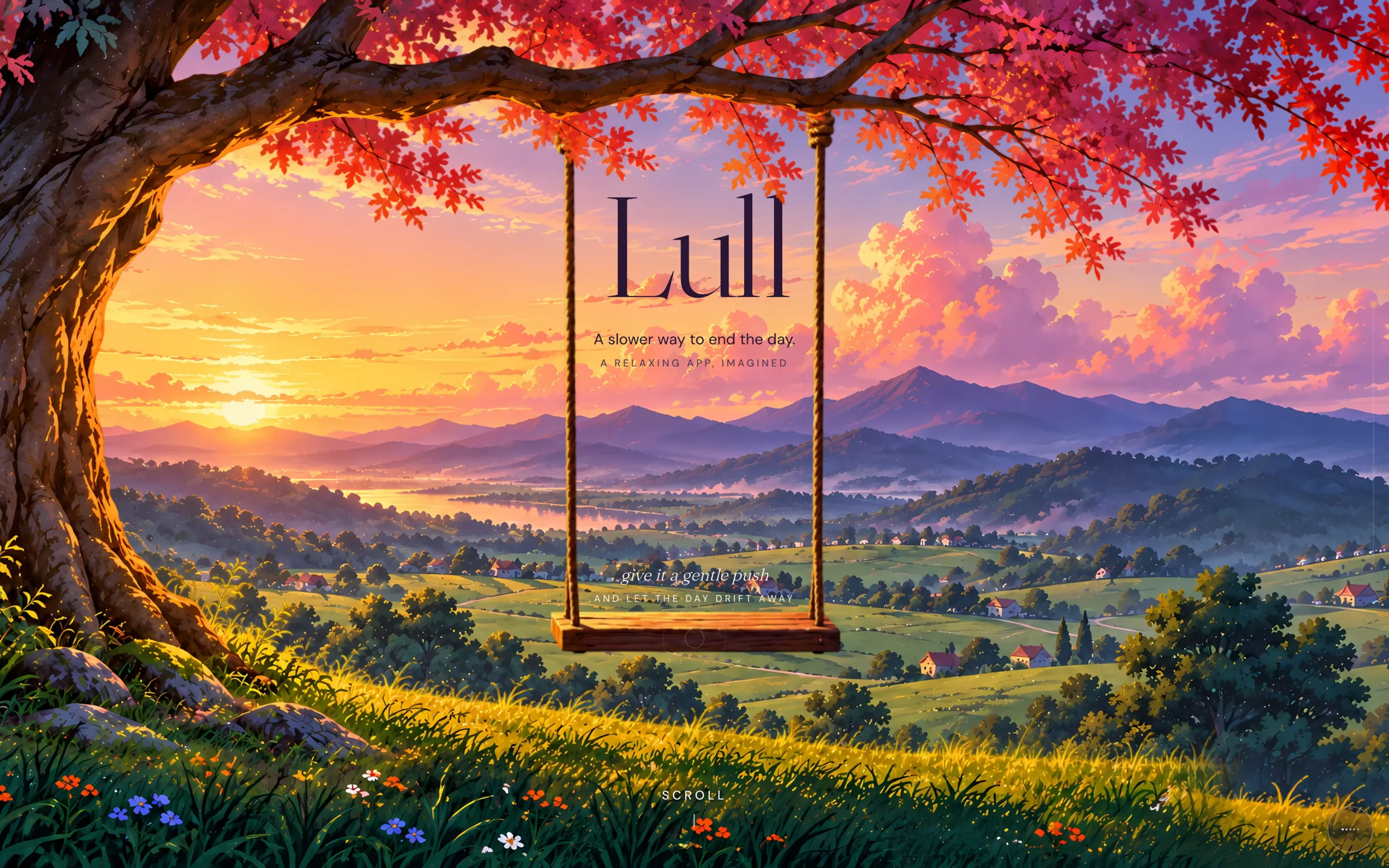
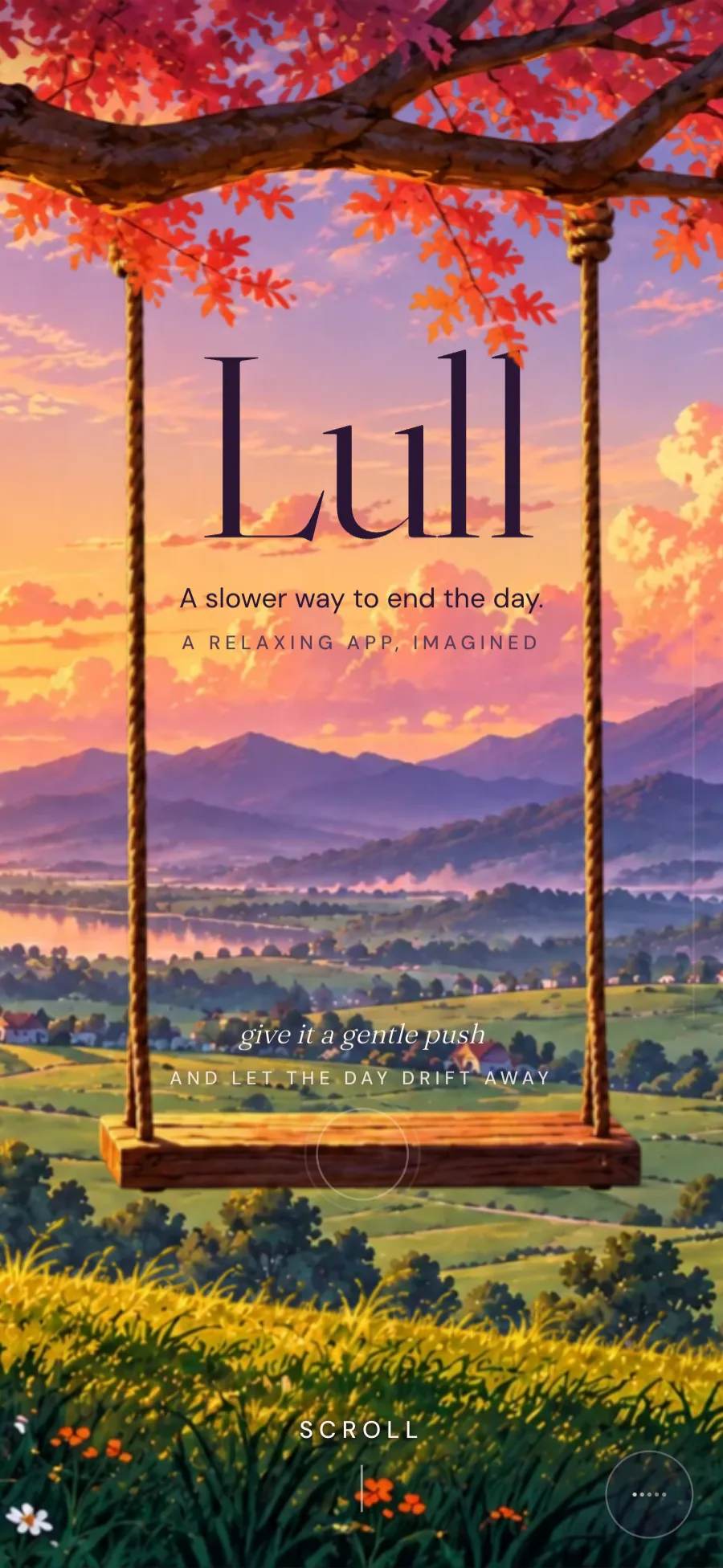
Lull is an app we imagined for the minutes before sleep, and a one-page site that tells its story as a single evening: the sun going down behind a swing, a night to slow down in, and a morning that starts rested.
An app that wants less of your evening, not more
Lull started as a question inside the studio: what would a wellbeing app look like if it refused every habit of the apps around it? No feed, no streaks, no badges, no reminder at ten o’clock asking where you have been. Just one gentle routine, about as long as a song, and then the phone goes quiet until morning.
The app itself is a concept. The website was the real brief: a page that sells the feeling before it sells a feature. Instead of a grid of screenshots and benefits, it tells one evening from start to finish, and the visitor slows down simply by scrolling through it.
We set ourselves the same rules we gave the app. Nothing loud, nothing that asks for attention it has not earned, and every effect there to help someone unwind. Music stays off until the visitor asks for it, and every animation has a still version for people who prefer reduced motion.
One evening, from sunset to night, without a single cut
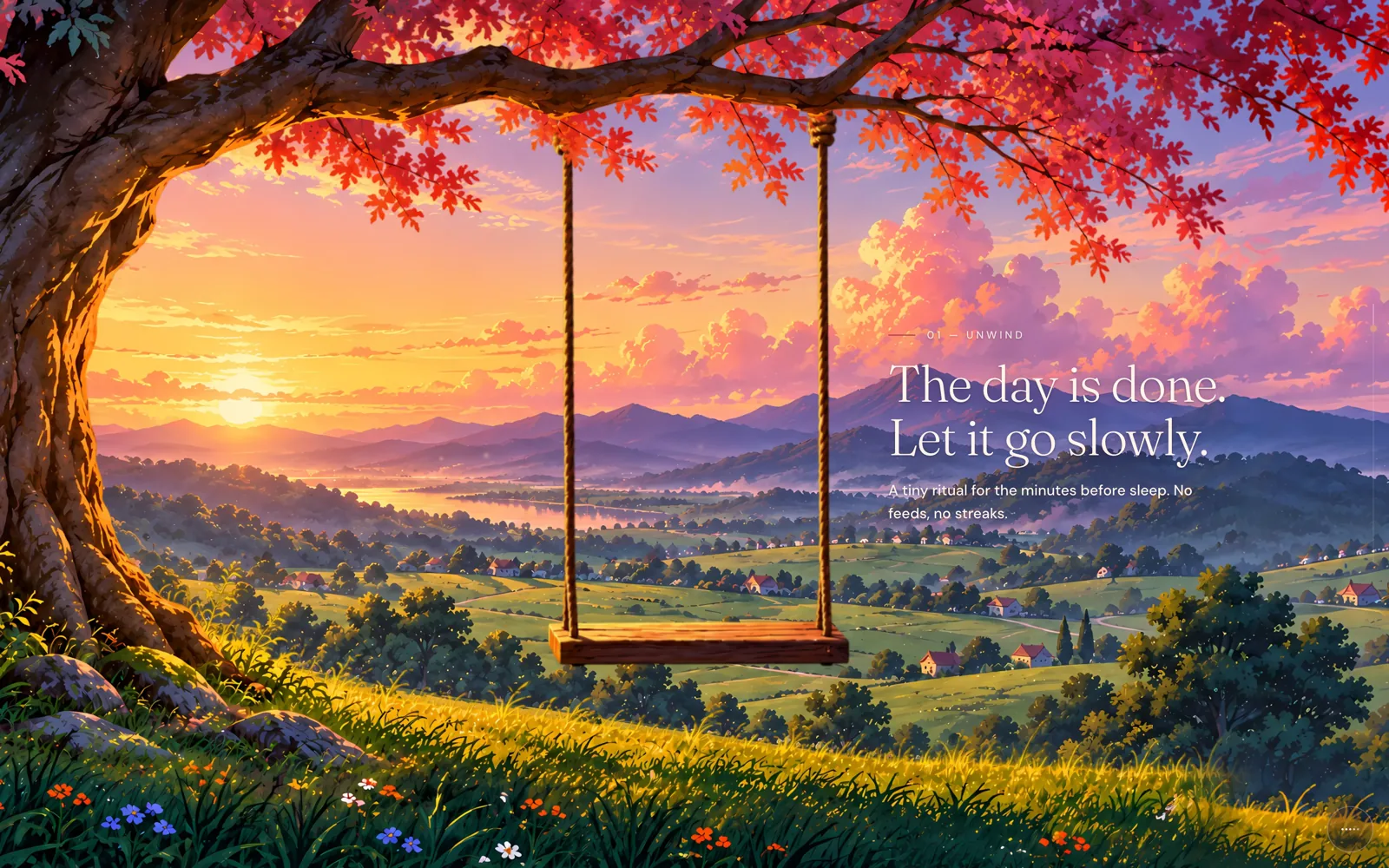
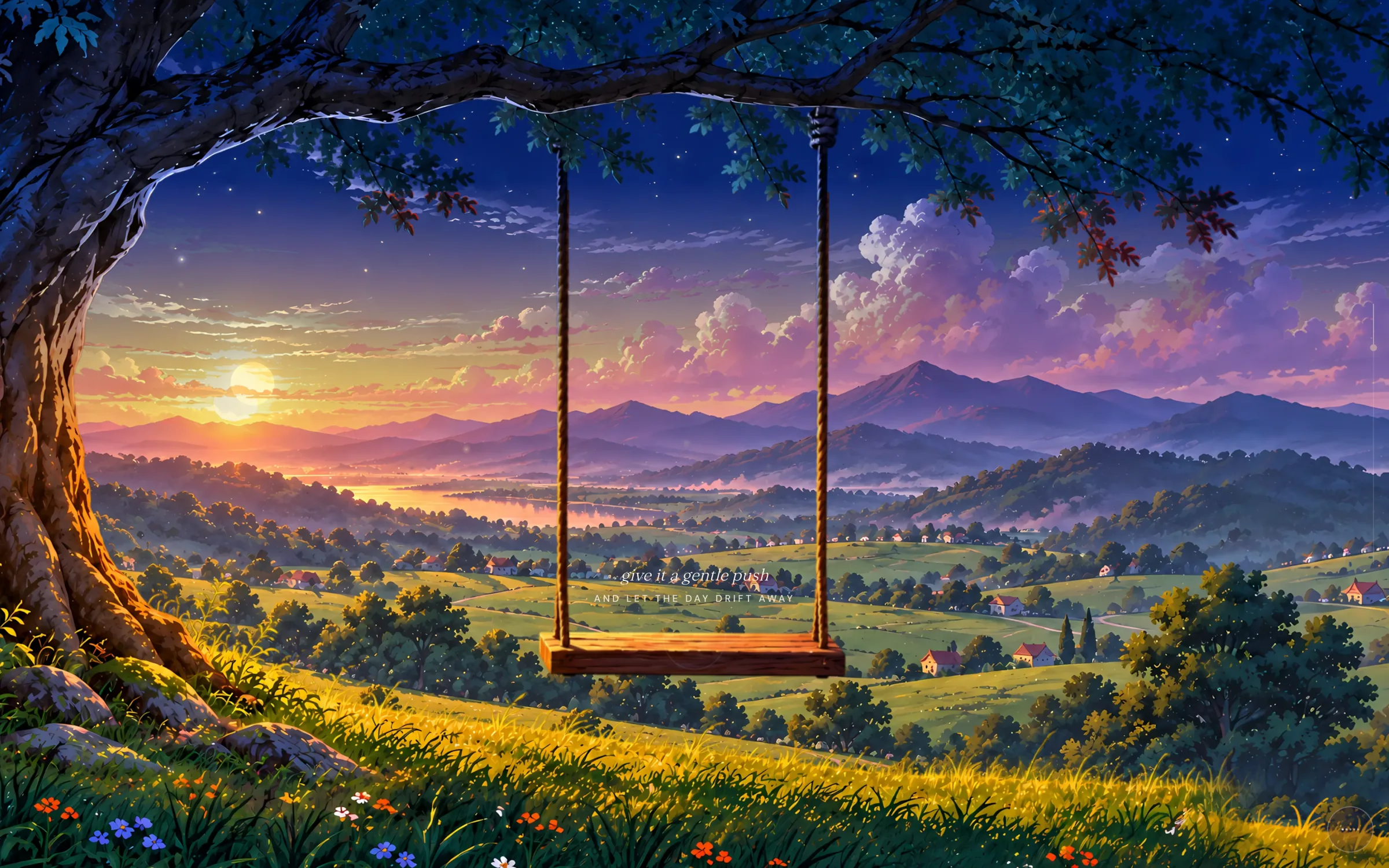
The home page opens on a swing hanging from an old tree, with a valley under a sunset sky. The scene is built from three painted layers, the sky and valley, the swing, and the tree with the grass, each in a day and a night version. As you scroll the scene stays pinned and the camera leans in: the valley barely moves while the tree and the swing come closer, so the picture has real depth.
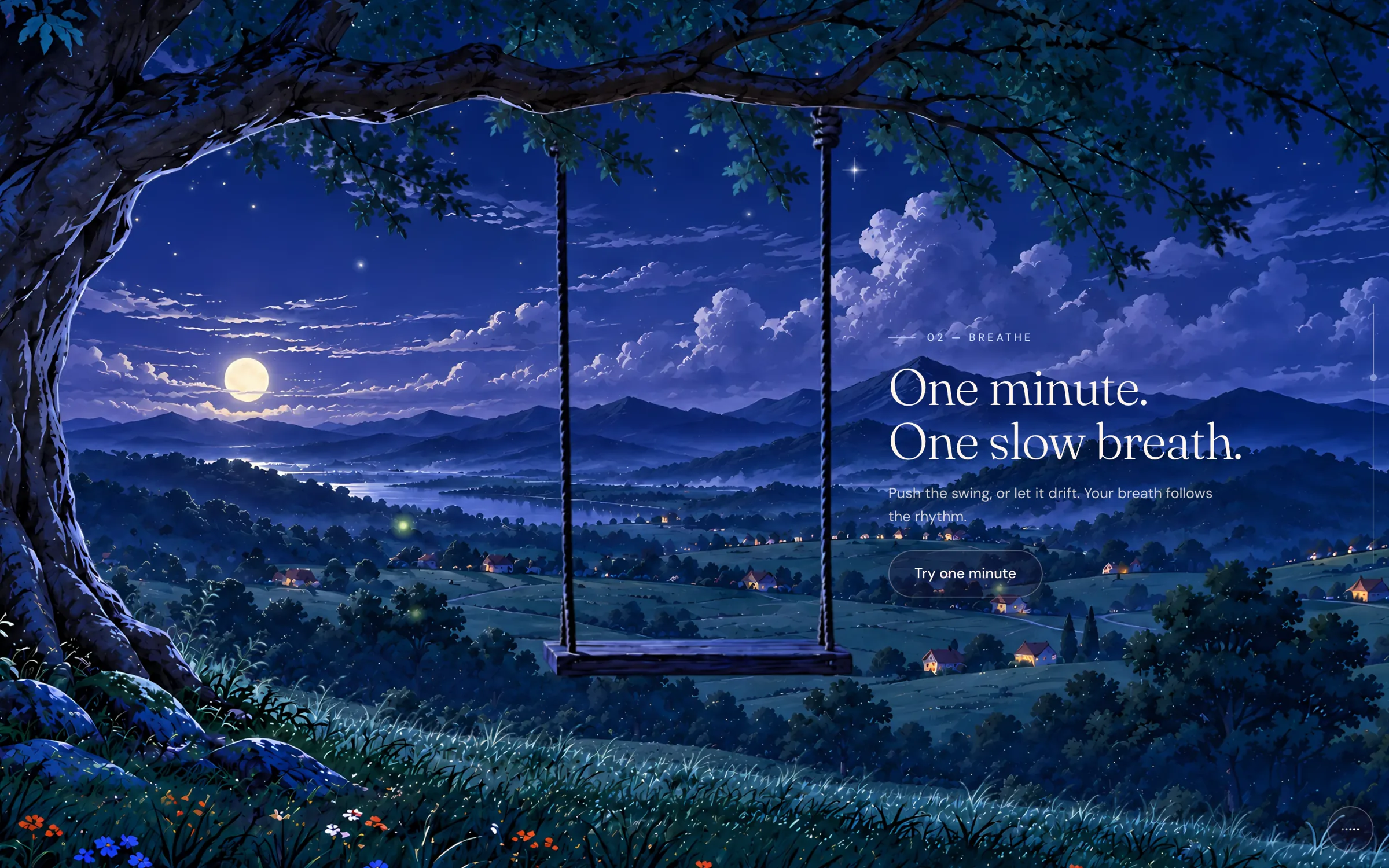
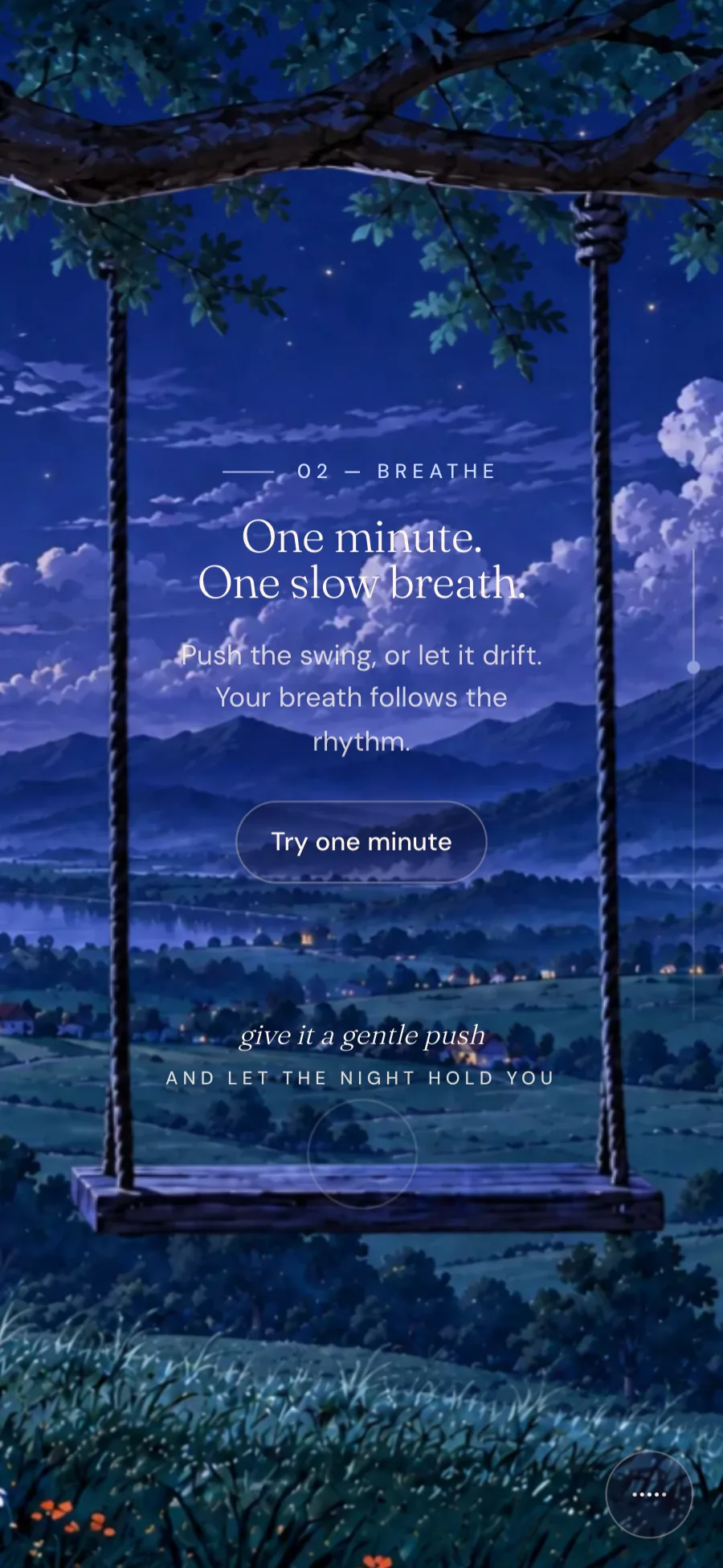
Halfway through, night falls. It does not fade in. It travels down the scene from the top of the tree, so for a moment the leaves are already dark and the sky is filling with stars while the valley below still holds the last of the sunset. The progress line on the right edge follows it too: its little dot glows warm by day and turns moonlit as night comes.
Each half of the evening has its own small life, drawn live on a canvas behind the swing. By day, the sun breathes with a slow, soft glow, dust motes drift in its light, and now and then a small flock of birds crosses the valley in a loose V. By night, painted stars brighten one at a time, the three brightest flaring into a faint cross, a rare shooting star crosses the sky, and fireflies blink far over the valley, drifting away from the cursor and easing back.
A swing you can push and a breath you can follow
The swing is never still. It moves as a real pendulum, kept going by a rider you never see, with a slowly wandering height and a touch of twist so it never reads as a machine. Drag it up or down and it follows your hand; tap it and it swings away from you. On arrival, and whenever the cursor rests on the seat, a quiet line invites a push: give it a gentle push, and let the day drift away. By night the line changes to: and let the night hold you.
The first push lets the music in. Lull’s theme is off by default and nothing is downloaded until someone asks for it. It fades in over a few seconds, fades out when the tab is hidden and remembers the choice for the next visit. The sound button in the corner shows five quiet dots that breathe while it is off; when it plays, they fade one by one as a wave rises out of them.
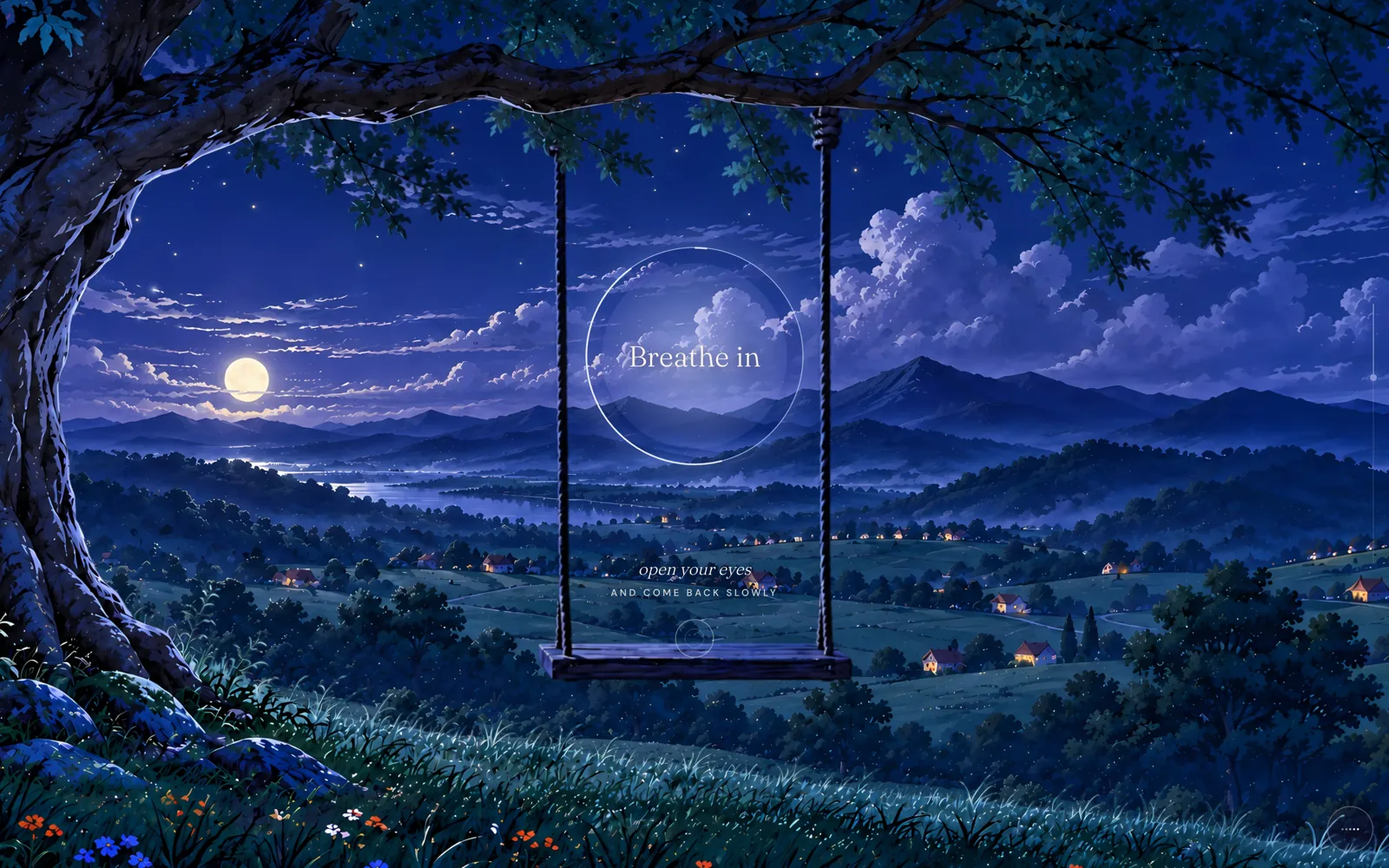
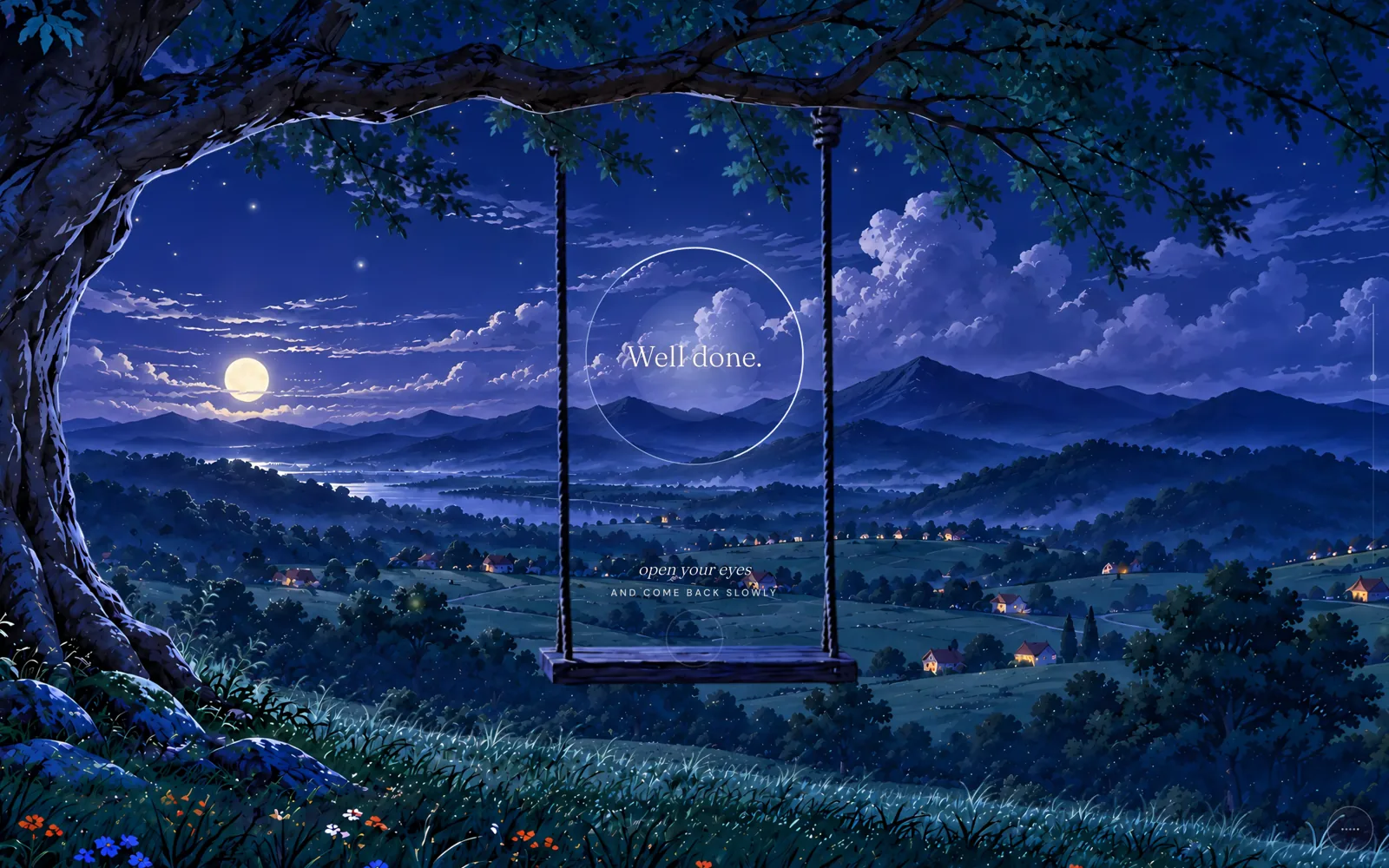
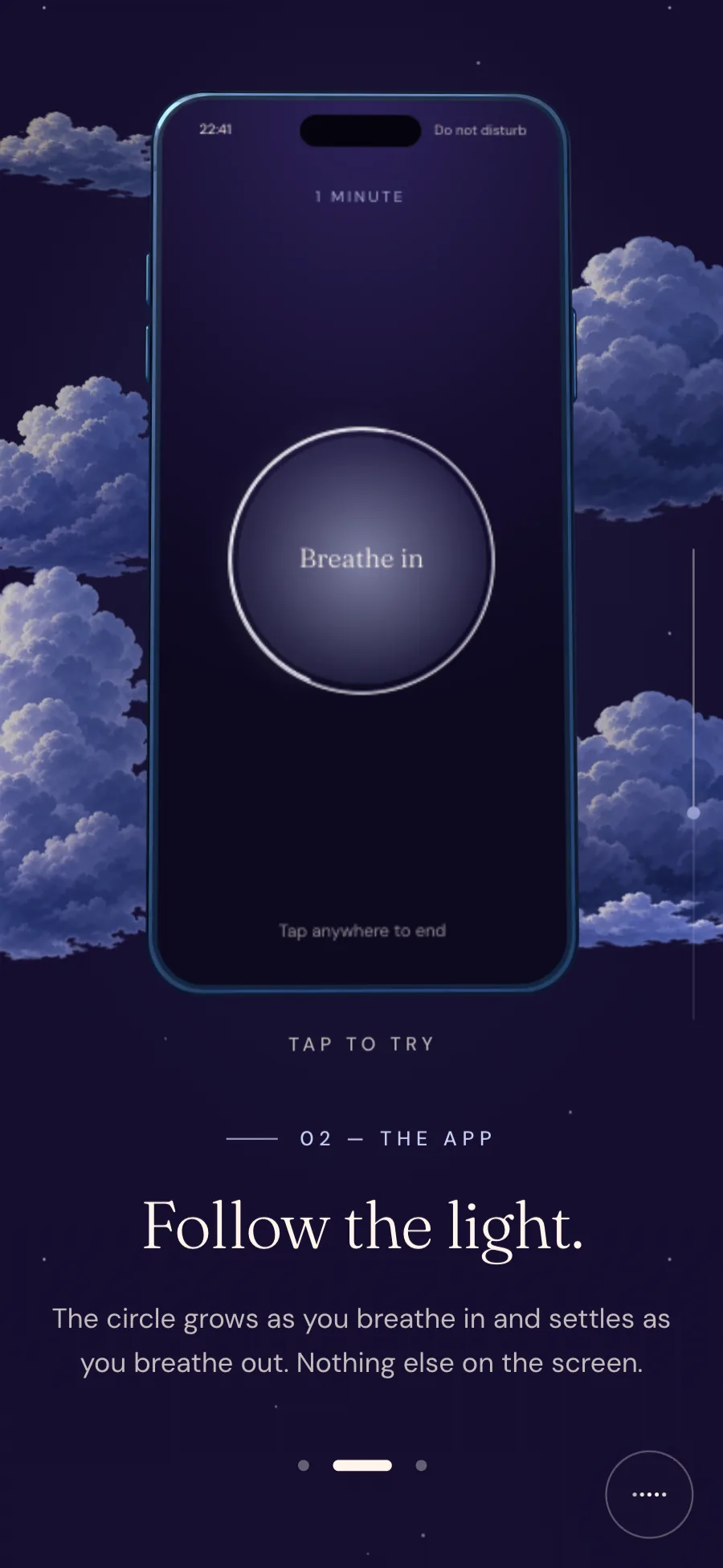
Try one minute starts a real breathing session in the scene. A circle hangs between the ropes, growing as you breathe in and settling as you breathe out, eight slow breaths that end on an exhale. An arc closes around it as the minute passes, the fireflies brighten and dim with each breath, and the swing locks to the rhythm, coming towards you on every inhale. At the end the circle comes to rest and says Well done. Press Escape or tap the swing to open your eyes and come back early.
Small things to touch in the dark
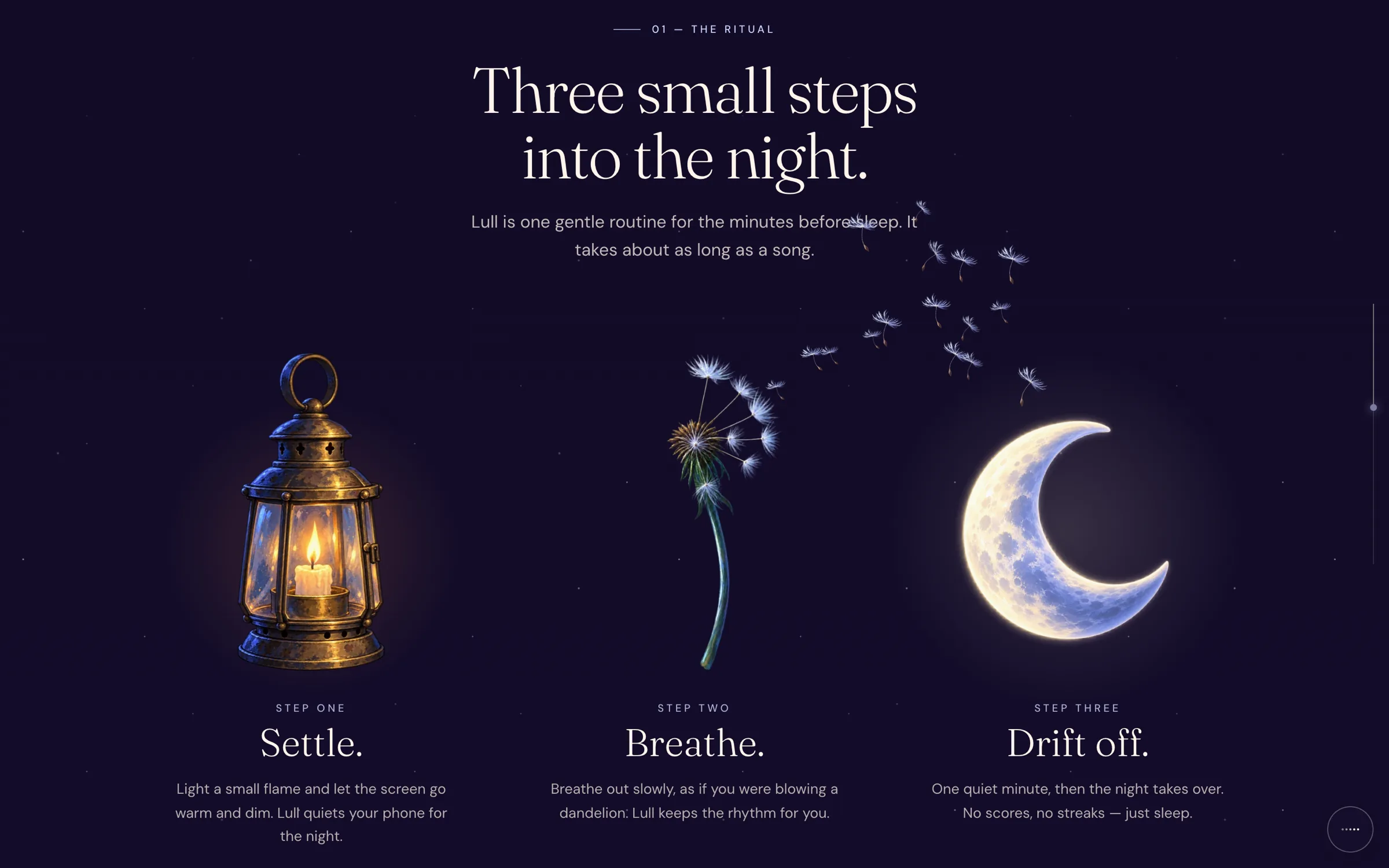
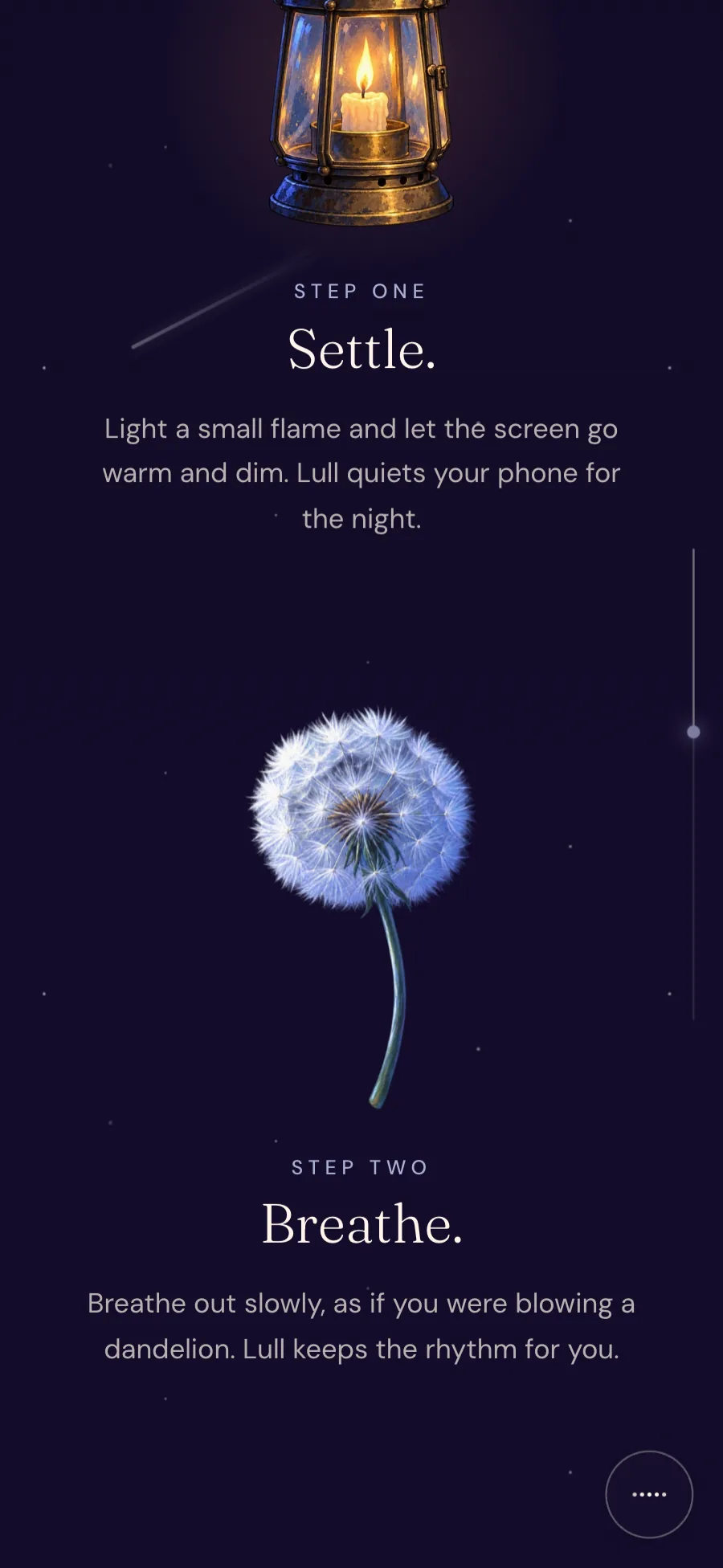
After the swing the page drops into the night sky, and every section has something to discover. The ritual is told with three floating objects that answer the cursor: the lantern’s flame grows, the dandelion lets its seeds go on your breath, and the crescent moon rocks gently. Objects drift with the cursor for depth, shooting stars cross the sky every few seconds, and a click anywhere on the sky sends one from that spot.
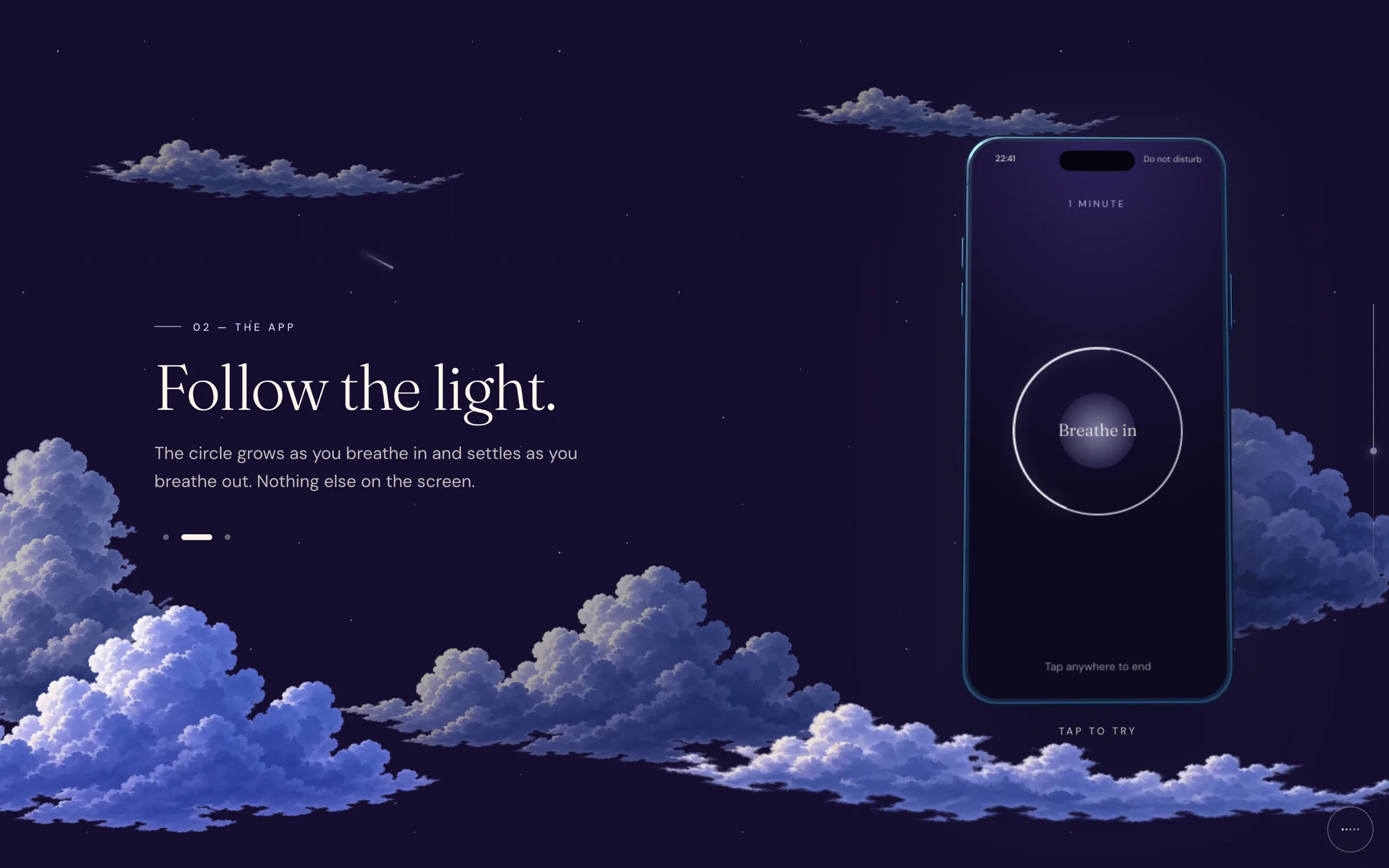
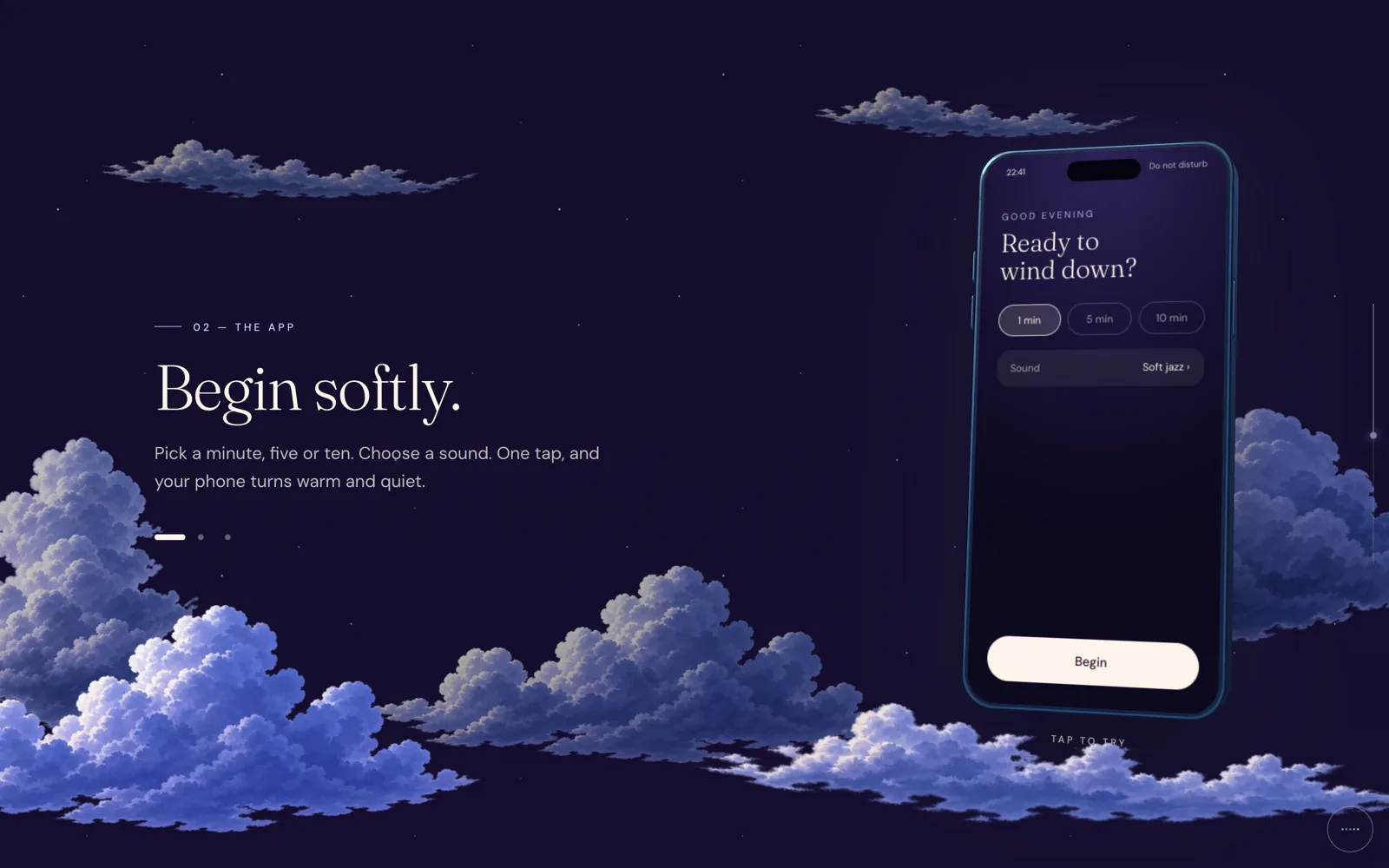
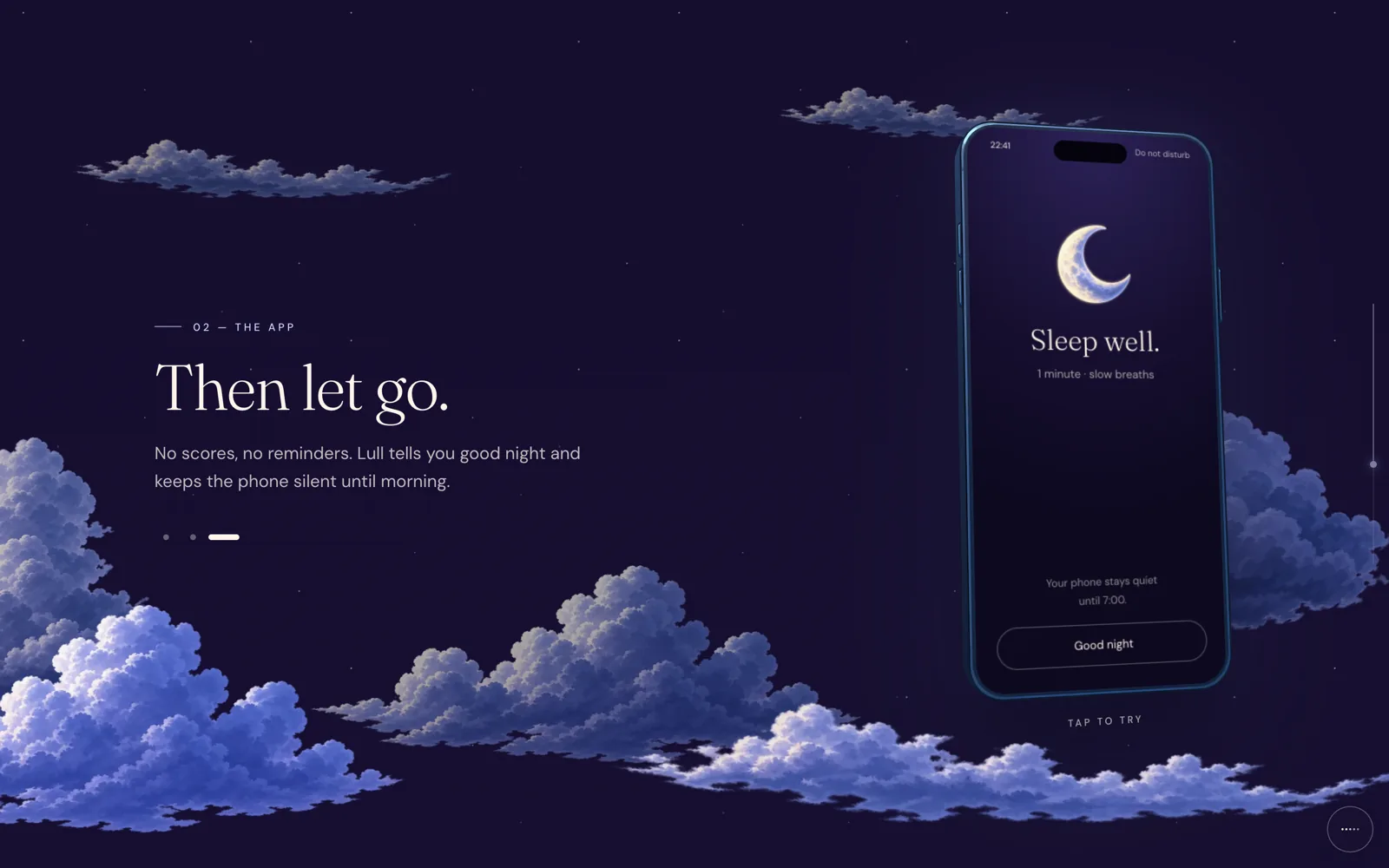
Then the app itself, in a phone floating among clouds. The section pins while you scroll, the phone turns slightly in 3D, its metal edge built from thin stacked slices, and clouds drift past in front of it and behind it at different depths. The three screens step through as you go: Begin softly, Follow the light, Then let go. The screens are real, not pictures: you can pick one, five or ten minutes, and the breathing screen runs a full session.
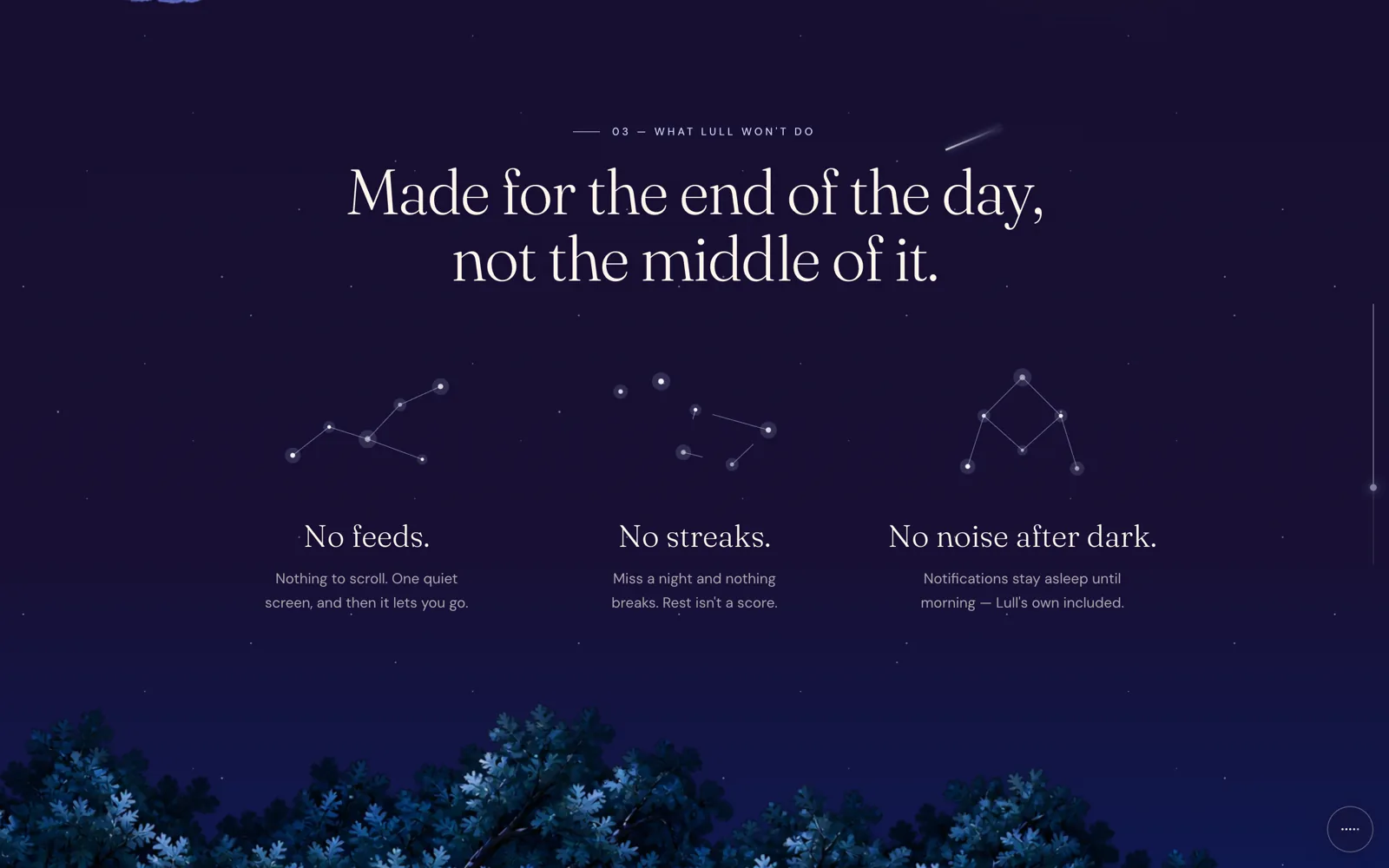
The promises close the night: no feeds, no streaks, no noise after dark. Each is drawn as a small constellation that joins itself up as it scrolls in. Hover one and its lines keep coming apart and joining up again; move away and every line draws itself back.
The night ends, and someone is on the swing
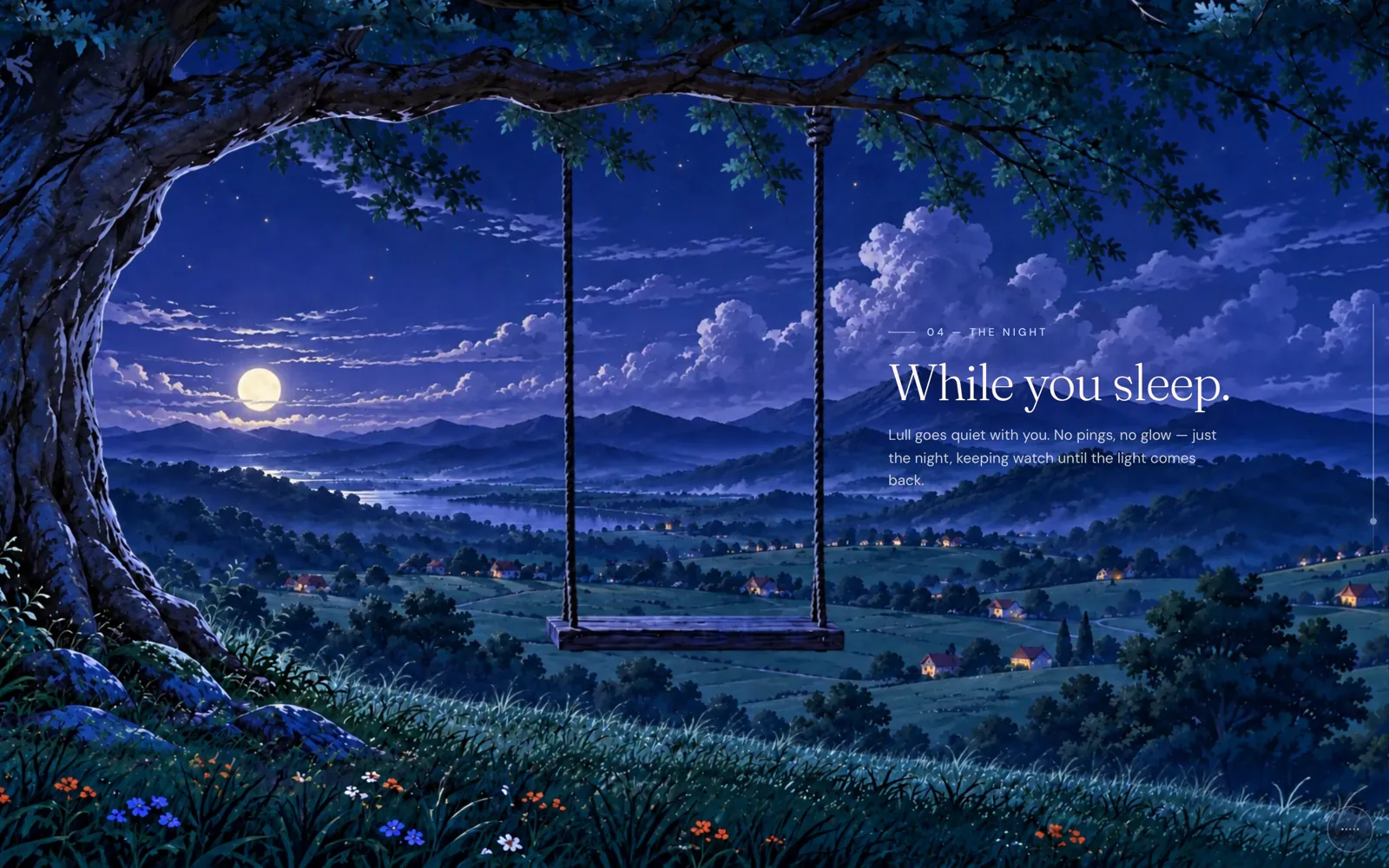
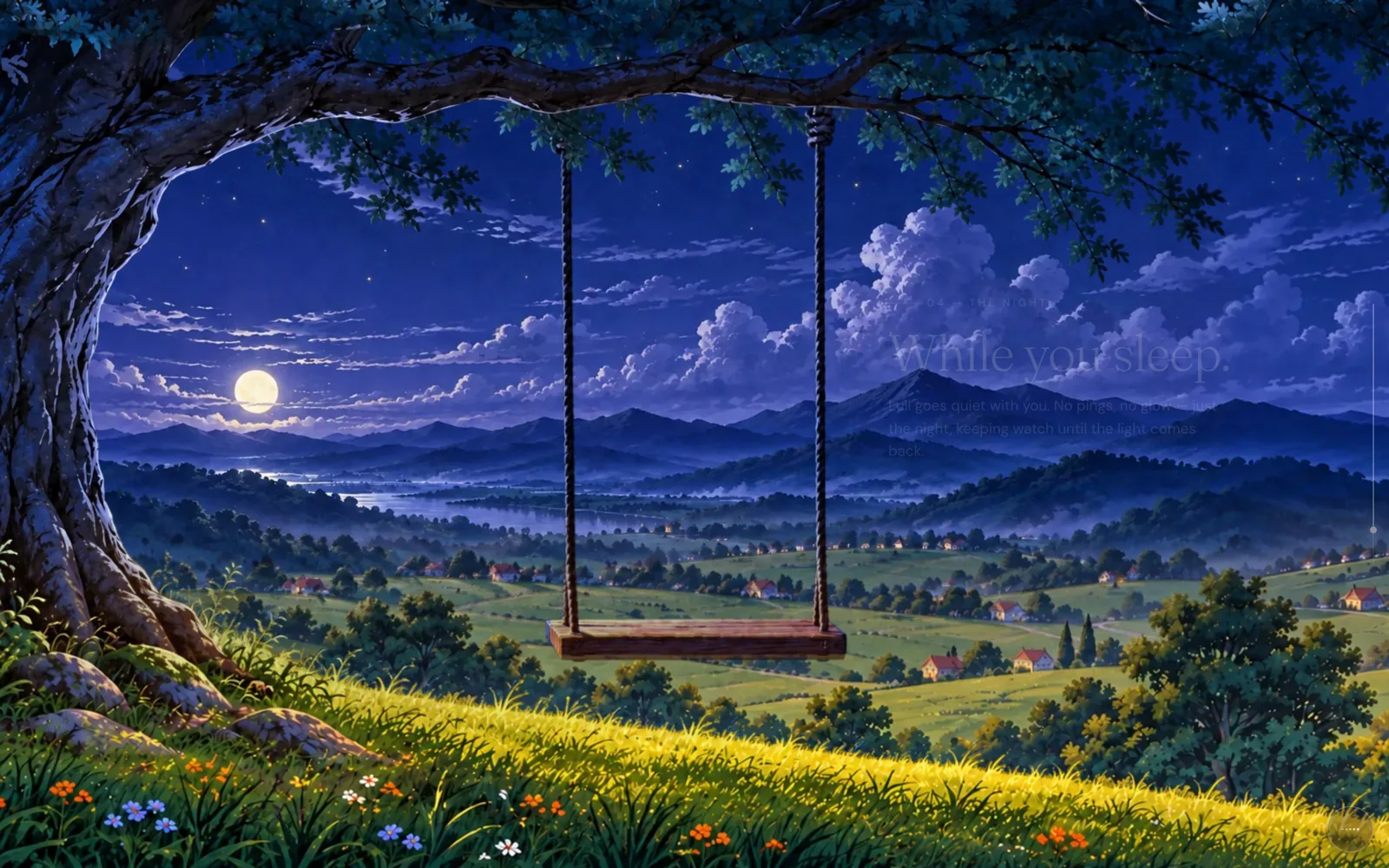
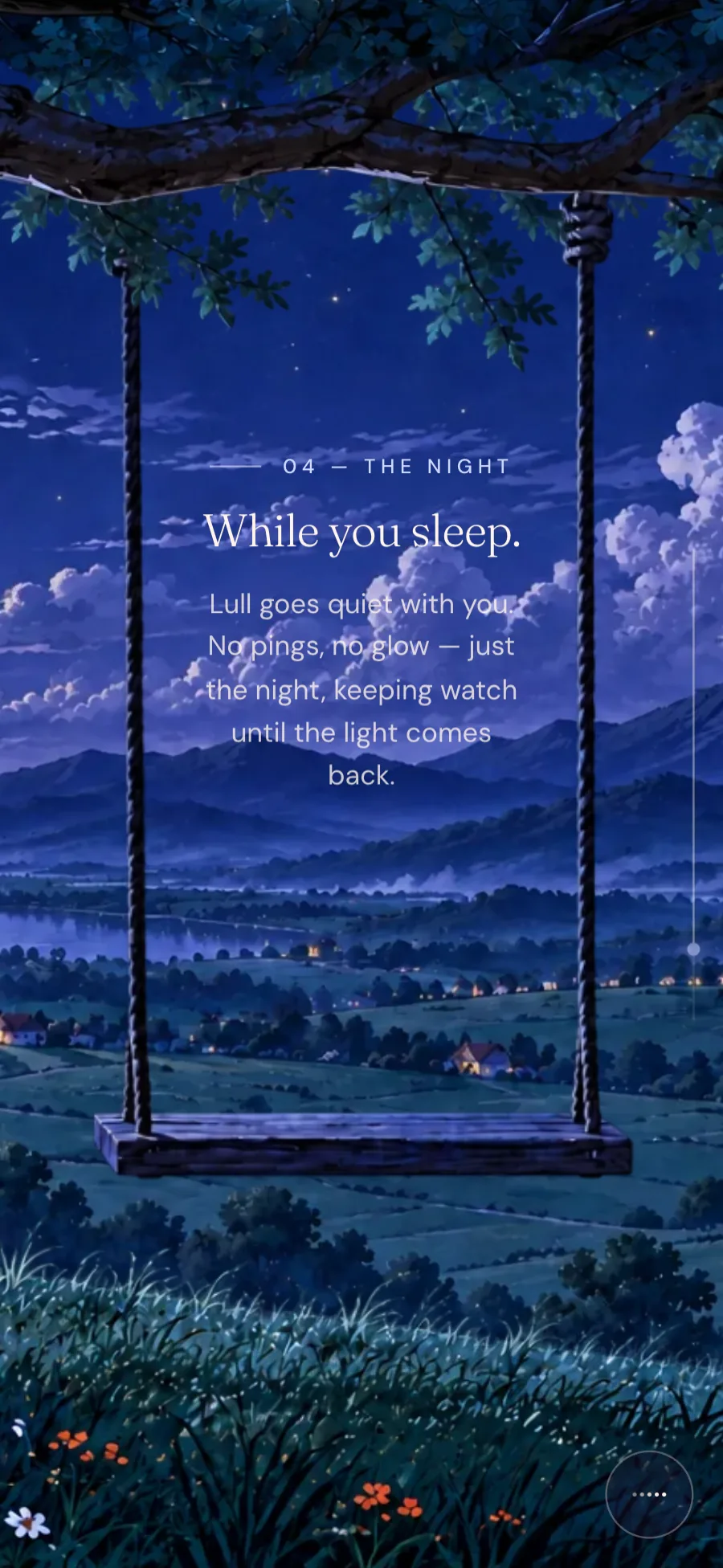
The story closes where it began. As the last section comes up, the tree’s night crown rises into view and the page lands back on the swing, now under a full moon. While you sleep, the copy reads: Lull goes quiet with you, keeping watch until the light comes back. Then it drifts off.
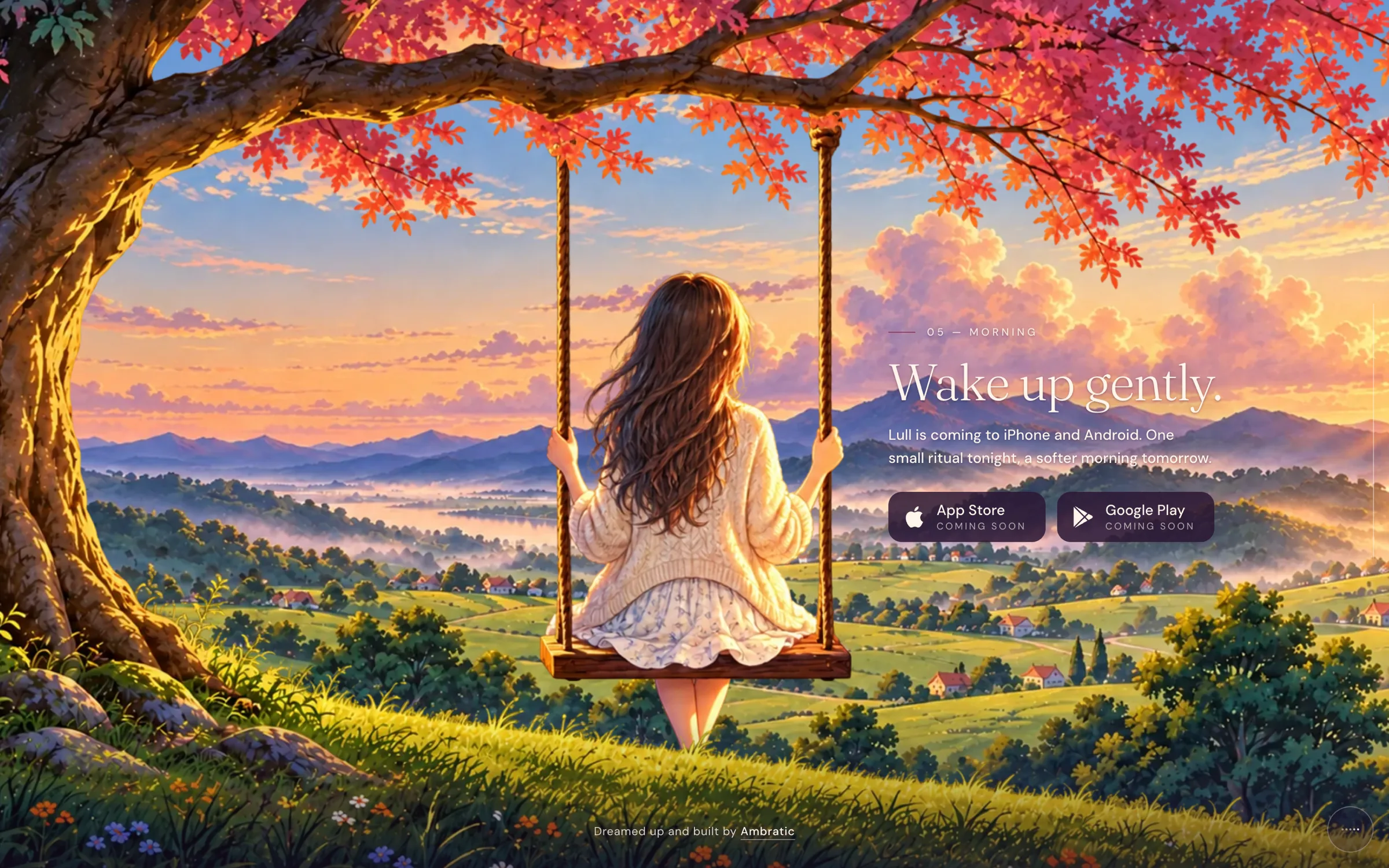
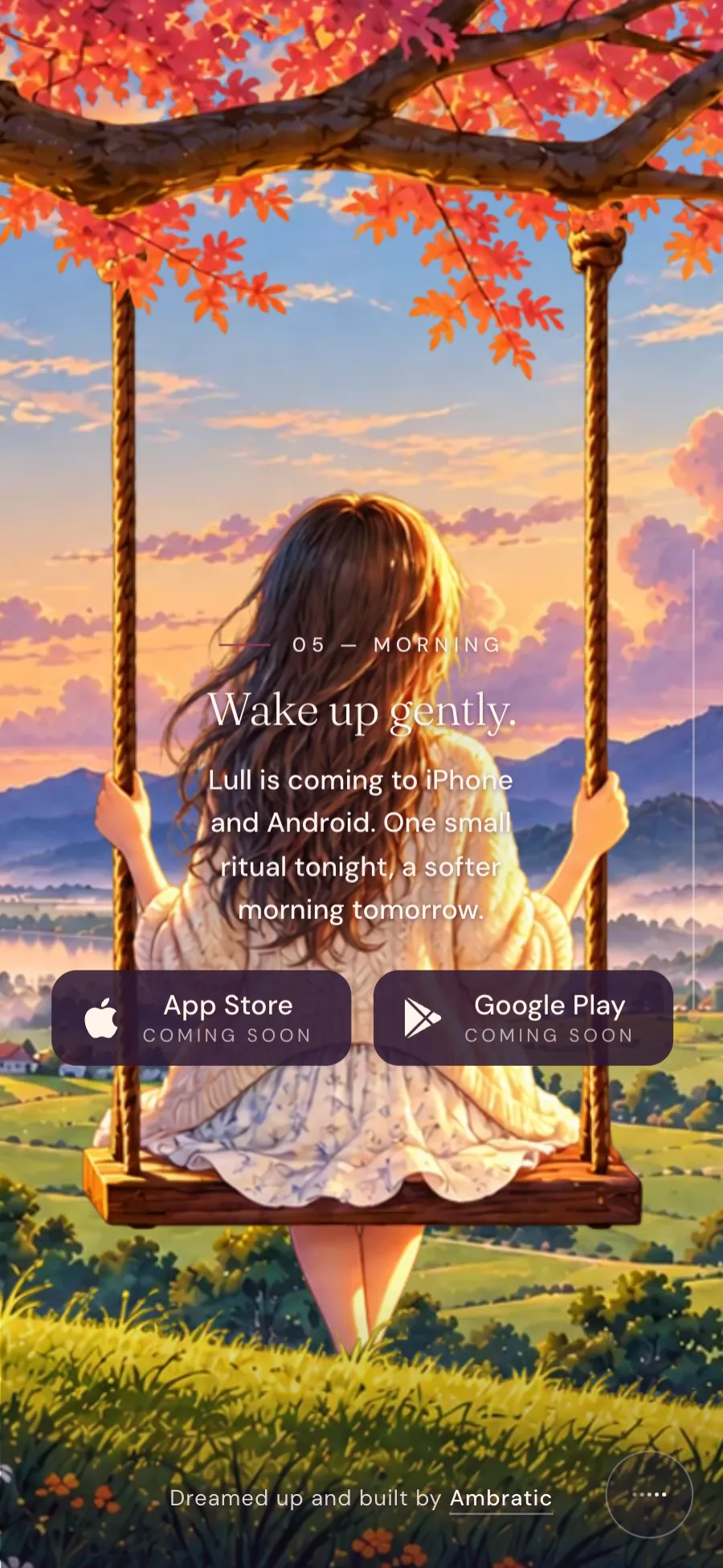
The morning is the mirror of the dusk. Light rises from the valley upwards, over the fields, the grass and finally the tree, and the moonlit sky gives way to a soft sunrise. When the light reaches the swing, someone is sitting on it, looking out over the valley. The empty swing that drifted all night settles into a gentle sway, and you can still give it a push.
Only then does the page ask for anything: Wake up gently, Lull is coming to iPhone and Android, with two quiet coming-soon badges and a last line saying who made it. One small ritual tonight, a softer morning tomorrow.
Keeping a painted evening smooth
A page made of large paintings, live canvases and a pendulum is easy to make beautiful and hard to make calm. A single stutter in the middle of a breathing exercise breaks the whole idea, so most of the engineering went into making the evening feel effortless on every screen.
Nightfall without repainting the scene
The first dusk was an animated mask, and every frame of it redrew the whole scene. On a fast scroll the tree and the swing went blank for a moment. Now the night sits in a frame that slides one way while its picture slides back the same amount, so the paintings stay put and only the soft edge moves. Only transforms change as you scroll, and nothing is repainted. The morning uses the same trick in reverse.
iOS Safari, one fix at a time
Smooth wheel scrolling made iOS wait for the page on every move of a finger, so touch screens keep native scrolling. The pinned scenes are sized to the large viewport, so the toolbar sliding in and out no longer reflows them, and their clipping lives inside the pin, because a clipping parent made Safari shake it while scrolling. Even the loader moved to the very start of the page, after a fast reload showed a frame of the bare scene before it appeared.
Paintings that load in the order you need them
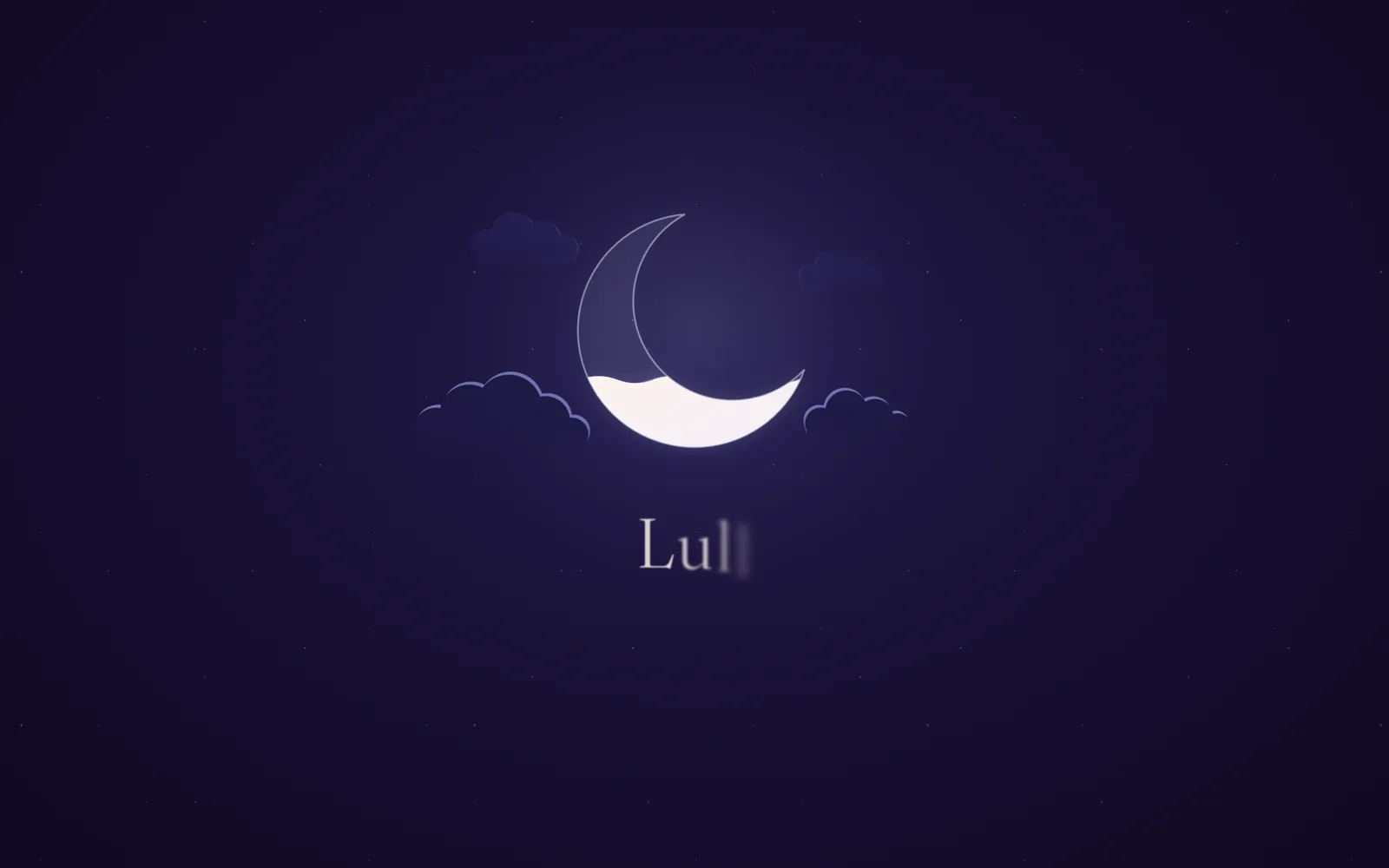
The day layers load first and sit under the loader while the crescent fills; the night layers only start once the day is in. Large and high-density screens get 4096px paintings, swapped in once they have loaded, and portrait phones get a narrow strip around the swing instead of the full panorama. The closing scene stays at 2048px on purpose: eight 4096px layers took more memory than the browser would keep decoded, and it briefly showed holes of night sky over the morning.
Running only what is on screen
Every scene, canvas and loop sleeps once it scrolls out of view and wakes when it comes back. The canvases are drawn at a capped pixel density, the scenes ease after the scroll so a dropped frame never makes the swing jump, and a hard flick of the wheel is limited so the evening can never race past.
A concept that shows what calm can feel like online
Lull is our answer to a question we kept hearing from clients: can a website feel calm and still be memorable? This one tells a whole evening in a single scroll, invites people to touch it instead of just read it, and leaves them a little slower than they arrived.
It is also a working lab for the studio. The layered scenes, the scroll wipes, the canvas life and the touch-friendly physics are all techniques we now bring to client work, and every one of them was tuned until it disappeared behind the story.
For us, the lesson was that slowness is a feature you have to engineer. The quieter the page, the more every stutter shows, and the more the work underneath has to be right.
- Performance on desktop
- 100
- Performance on mobile
- 94
- Accessibility
- 100
- Layout shift
- 0
MORE WORK